
One of the most common questions players ask is simple: how wide is a bowling lane? But the answer opens the door to a much deeper system of design, physics, and gameplay strategy.
If you’ve ever stepped into a bowling alley and wondered how everything feels so precise, you’re not imagining it. Every inch of a bowling lane is engineered for consistency, fairness, and repeatable performance.
A regulation bowling lane is not just a strip of wood or synthetic material it is a carefully standardized playing surface where millimeters can influence ball direction, hook potential, and scoring outcomes.
Let’s break it down in detail.
Facts Table:
| Category | Specification | Details / Insight |
|---|---|---|
| Standard lane width | 42 inches (3.5 feet) | Official regulation width used worldwide |
| Total lane structure width | ~60 inches | Includes lane + both gutters |
| Number of boards | 39 boards | Wooden or synthetic strips forming the lane |
| Board width (approx.) | ~1.08 inches | Each board runs full 60 ft length |
| Center reference | Board 20 | Exact middle of the lane used for targeting |
| Lane length (foul line to headpin) | 60 feet | Fixed international standard |
| Total playing system length | 86.5 feet | Includes approach + lane + pin deck |
| Approach area length | 15–18 feet | Space for footwork and momentum |
| Foul line width | 3/8–1 inch | Boundary line for legal delivery |
| Gutter width (each side) | ~9.25 inches | Captures missed balls |
| Gutter depth | ~1.875 inches | Helps guide ball return system |
| Flatness tolerance | ≤ 0.040 inches | Extremely strict surface precision |
| Pin spacing (center-to-center) | 12 inches | Ensures equal pin distribution |
| Pin triangle size | 36 inches per side | Equilateral formation of 10 pins |
| Headpin distance | 60 feet | From foul line center point |
| Arrow placement distance | 15 feet | Used for aiming and targeting |
| Oil pattern length | ~38–42 feet | Controls ball friction and hook |
| Dry backend length | ~18–22 feet | Where ball typically hooks sharply |
| Rule of 31 | Pattern length − 31 | Estimates breakpoint board |
Exact Answer: How Wide Is a Bowling Lane?
Standard Bowling Lane Width in Inches and Feet
A regulation bowling lane is:
- 42 inches wide
- 3.5 feet wide
This measurement represents only the active playing surface, not including gutters.
Across all certified bowling facilities, this width is standardized and does not change whether you are bowling in the United States, Europe, or Asia.
As the United States Bowling Congress (USBC) states in its equipment specifications:
“All regulation lanes must maintain uniform width and surface conditions to ensure fair play across certified competition environments.”
This strict standard is what allows professional bowlers to compete globally under identical conditions.
What Makes Up the Bowling Lane Width?
To truly understand bowling lane dimensions, you need to go beyond the simple 42-inch number.
A bowling lane is made up of multiple structural layers and components.
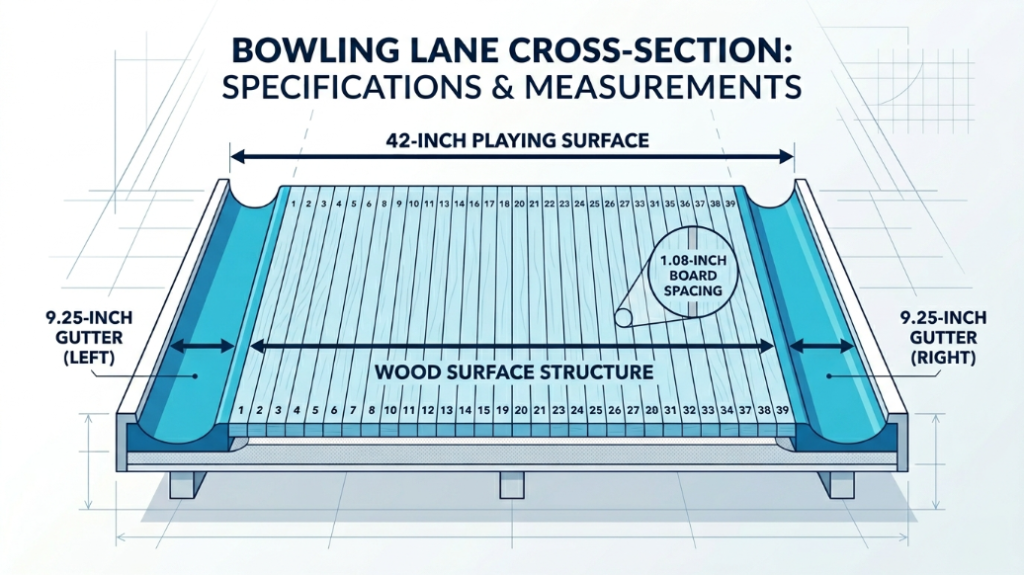
Playing Surface Width (Core Lane Area)
The actual playable surface includes:
- 42 inches total width
- Constructed from 39 individual boards
- Each board is approximately 1.08 inches wide
These boards run the full 60-foot lane length from foul line to headpin.
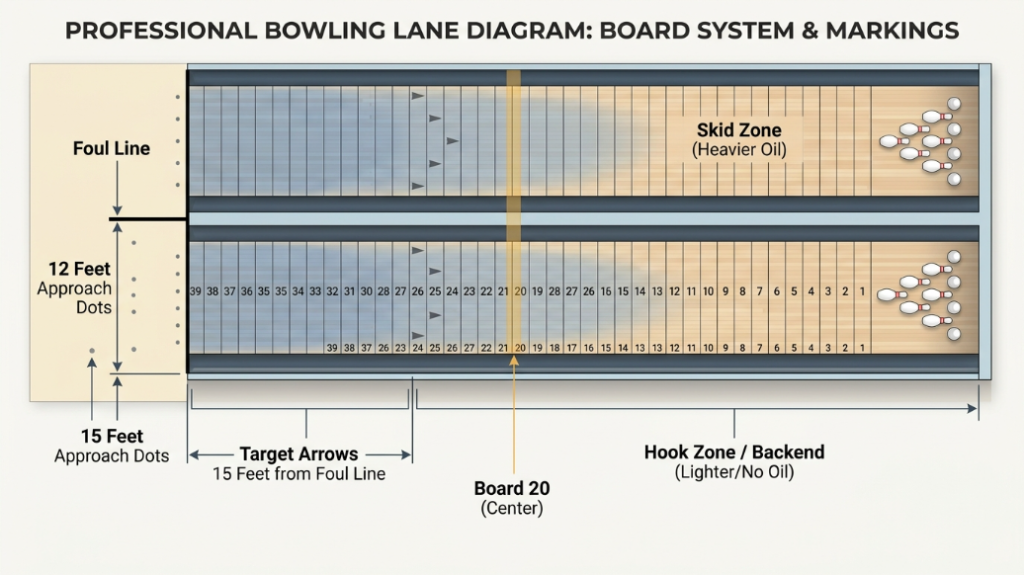
The center of the lane is marked by Board 20, which is the most important reference point for aiming and alignment.
Total Width Including Gutters
On both sides of the lane are gutters:
- Each gutter is approximately 9.25 inches wide
- Designed to catch off-target balls
- Prevent interference between adjacent lanes
When you include gutters, the total system width expands significantly:
- Approx. 60 inches total structure width
However, only the 42-inch section is considered “in play.”
Why Gutters Are Not Part of Lane Width
Gutters are not part of the official bowling lane width because:
- They are not playable surfaces
- They are designed purely for error capture
- They protect neighboring lanes
- They maintain scoring integrity
This separation ensures that every missed shot has a consistent consequence across all lanes.
Bowling Lane Engineering: How 39 Boards Create Precision
A bowling lane may look smooth and simple, but it is actually a precision-engineered surface.
Board Construction System
Each lane consists of:
- 39 wooden or synthetic boards
- Full 60-foot length alignment
- Perfect lateral spacing (~1.08 inches per board)
The boards are tightly joined to maintain a uniform surface. Even tiny deviations can affect ball motion.
Center Alignment: Why Board 20 Matters
The lane’s geometry is built around a central reference:
- Board 1 = far left edge
- Board 20 = exact center
- Board 39 = far right edge
Professional bowlers often reference board numbers instead of aiming at pins.
For example:
- “Start on board 18”
- “Target board 14 at the arrows”
This system converts a wide visual space into precise mathematical control.
Flatness Tolerance and Precision Standards
Modern lanes must maintain extremely tight tolerances:
- Surface variation: ≤ 0.040 inches
To put that into perspective:
- That is thinner than a standard credit card
Why does this matter?
Because even slight unevenness can:
- Change ball friction
- Alter hook angle
- Impact scoring consistency
This is why bowling is considered one of the most precision-sensitive sports in facility engineering.
Why Bowling Lane Width Feels Wider Than It Is
Many beginners assume the lane is much wider than 42 inches. This is a common illusion.
Distance Compression Effect
The lane stretches:
- 60 feet from foul line to pins
This long distance creates a visual compression effect, making the lane appear wider and more forgiving than it actually is.
Role of Target Markings
The lane includes:
- Target arrows (15 feet from foul line)
- Approach dots (12–15 feet behind foul line)
- Board numbering system
These markings create visual structure that guides aiming. Without them, the narrow width would feel far more restrictive.
Psychological Impact on Players
Beginners tend to:
- Aim at pins directly
- Misjudge lateral distance
- Overestimate lane width
Professionals, however:
- Focus on boards and arrows
- Ignore pin location for aiming
- Rely on repeatable geometry
This shift in perception is key to improving accuracy.
How Bowling Lane Width Affects Ball Motion
Lane width is directly tied to how a bowling ball travels, hooks, and strikes pins.
Board Targeting System
Instead of aiming at pins, bowlers use:
- Boards (lateral control)
- Arrows (mid-lane targeting)
- Breakpoints (oil transition zones)
Even a 1–2 board shift can completely change the ball’s trajectory.
Oil Pattern Interaction
Lane width becomes even more important when combined with oil patterns:
- Oiled zones = reduced friction
- Dry zones = increased hook
- Transition zones = unpredictable motion
A small change in starting position within the 42-inch width can drastically change ball reaction.
Skid-Flip Ball Behavior
Modern bowling balls follow a three-phase motion:
- Skid phase (on oil)
- Hook phase (transition zone)
- Roll phase (dry backend)
Lane width determines how much room the ball has to transition between these phases.
Lane Width vs Other Sports Surfaces
Bowling lanes are unusually narrow compared to other sports surfaces.
Comparison Table
| Sport | Width | Key Insight |
|---|---|---|
| Bowling lane | 42 inches | Extremely precision-based |
| Cricket pitch | 10 feet | Wider tactical space |
| Tennis court (singles) | 27 feet | Large lateral movement |
| Basketball court | 50 feet | Full-body motion sport |
Bowling stands out because:
- It is highly constrained laterally
- Small movements have large effects
- Precision matters more than power
Why Bowling Lane Width Is Standardized Worldwide
One of the most important aspects of bowling is global consistency.
International Standardization
All certified lanes follow identical specifications:
- Same width (42 inches)
- Same length (60 feet to pins)
- Same board system
This ensures:
- Fair competition
- Skill-based outcomes
- Global tournament consistency
Historical Stability of Lane Design
Interestingly, the modern lane design has remained largely unchanged for over a century.
Why?
Because the system already achieves:
- Balanced difficulty
- Predictable physics
- Scalable skill progression
Changing lane width would completely disrupt the sport’s physics and scoring balance.
Common Misconceptions About Bowling Lane Width
“Lanes are wider in recreational centers”
False. Even casual bowling alleys use regulation width.
“Gutters are part of the lane”
Incorrect. Gutters are separate systems designed for error capture only.
“Lane width varies by country”
Also false. Certified lanes follow global standards.
How Professionals Use Lane Width Strategically
Elite bowlers treat lane width like a coordinate system.
Board-Based Strategy
They:
- Adjust starting position by 1–2 boards
- Aim at specific arrows
- Track ball path across defined zones
Example:
- Start on board 25
- Target arrow 2
- Break at board 10–12
The 3-6-9 Spare System
A common professional method:
- 3 boards = small adjustment (near-center spares)
- 6 boards = medium adjustment
- 9 boards = corner spares
This system uses lane width as a precision adjustment grid.
Expert Insight: Why 42 Inches Is the Perfect Width
The 42-inch bowling lane width is not arbitrary it is the result of balancing physics, fairness, and skill progression.
Why It Works
- Narrow enough to reward precision
- Wide enough for controlled hook motion
- Consistent for global standardization
- Compatible with oil-based lane physics
If the lane were wider:
- Scoring would increase too easily
- Skill differentiation would decrease
If narrower:
- The game would become too punishing
- Casual play would suffer
The current width sits in a “perfect difficulty zone.”
Practical Tips to Use Lane Width to Improve Your Game
Understanding lane width is not just theory it directly improves performance.
Key Tips
- Always aim using boards, not pins
- Learn your natural starting board
- Adjust stance by 1 board at a time
- Focus on arrow targeting (15 ft zone)
- Track ball reaction across the width
Beginner Mistake to Avoid
Most beginners:
- Stand too centered
- Aim directly at pins
- Ignore board alignment
Fixing this alone can dramatically improve scores.
Frequently Asked Questions
Are all bowling lanes the same width?
Yes, all regulation bowling lanes are standardized at 42 inches wide worldwide. Small variations only exist in non-certified or home setups.
Is Lane 7 adults only?
It depends on the bowling center, not a universal rule. Some venues may reserve certain lanes for leagues or adults during busy hours.
What is the 31 rule in bowling?
The Rule of 31 helps find your breakpoint by subtracting 31 from the oil pattern length. It estimates where the ball should exit the oil to start hooking.
What size is a small bowling lane?
Mini or home bowling lanes are usually 25–35 feet long with reduced width. They are not regulation size and are used for recreation only.
What is the 3 6 9 rule in bowling?
The 3-6-9 rule adjusts your feet by 3, 6, or 9 boards to hit different spare shots. It helps maintain the same target while changing stance.
How wide is a normal bowling lane?
A normal bowling lane is exactly 42 inches (3.5 feet) wide. This is the official standard used in all certified bowling alleys.
Conclusion
So, how wide is a bowling lane? The answer 42 inches seems simple, but it represents one of the most precisely engineered surfaces in all of sports.
Every board, every inch, and every gutter exists for a reason. The narrow width is what makes bowling a true skill-based game where control, accuracy, and consistency matter more than power.
Once you understand the lane as a structured system not just a playing surface you start to see bowling differently. Every shot becomes a calculation, and every inch of that 42-inch width becomes an opportunity for mastery.