
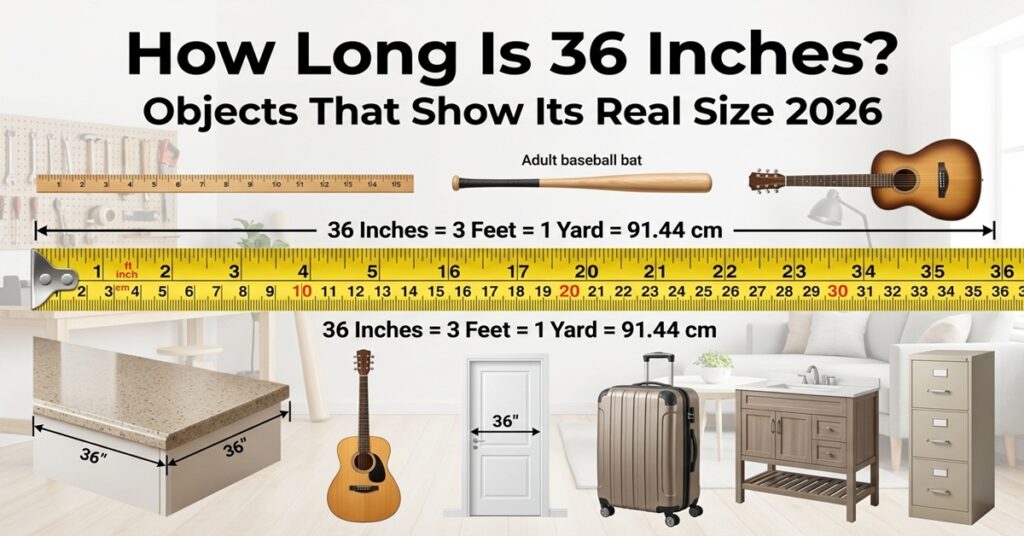

If you’ve ever wondered how long is 36 inches, the simple answer is that 36 inches equals 3 feet, 1 yard, 91.44 centimeters, or 0.9144 meters.
While the conversion is straightforward, many people struggle to visualize what 36 inches actually looks like in real life. Whether you’re shopping for furniture, measuring a room, comparing luggage sizes, or working on a DIY project, understanding this dimension can help you make better decisions.
The good news is that 36 inches appears everywhere in daily life. From kitchen countertops and yardsticks to baseball bats and doorways, many common objects are built around this standard measurement.
In this guide, you’ll learn exactly how long 36 inches is, how it compares to other measurements, and which everyday objects can help you visualize it instantly.
36 Inches Converted Into Other Units
Before looking at real-world examples, it helps to understand how 36 inches compares to other common units of measurement.
| Measurement Unit | Equivalent to 36 Inches |
|---|---|
| Feet | 3 feet |
| Yards | 1 yard |
| Centimeters | 91.44 cm |
| Meters | 0.9144 m |
| Millimeters | 914.4 mm |
This means that whenever someone mentions a yard, they’re talking about the same length as 36 inches.
Why These Conversions Matter
Different countries use different measurement systems.
- The United States primarily uses inches and feet.
- Most countries use centimeters and meters.
- Construction projects often require conversions between both systems.
- Product dimensions may vary depending on where an item is manufactured.
Knowing these equivalents helps eliminate confusion when comparing dimensions.
Quick Ways to Visualize 36 Inches
Numbers alone don’t always create a clear picture. Visual comparisons are often much easier to understand.
Here are some quick ways to imagine 36 inches:
- A standard yardstick
- The height of most kitchen countertops
- The width of many accessibility doors
- About the height of an average 3-year-old child
- A large adult baseball bat
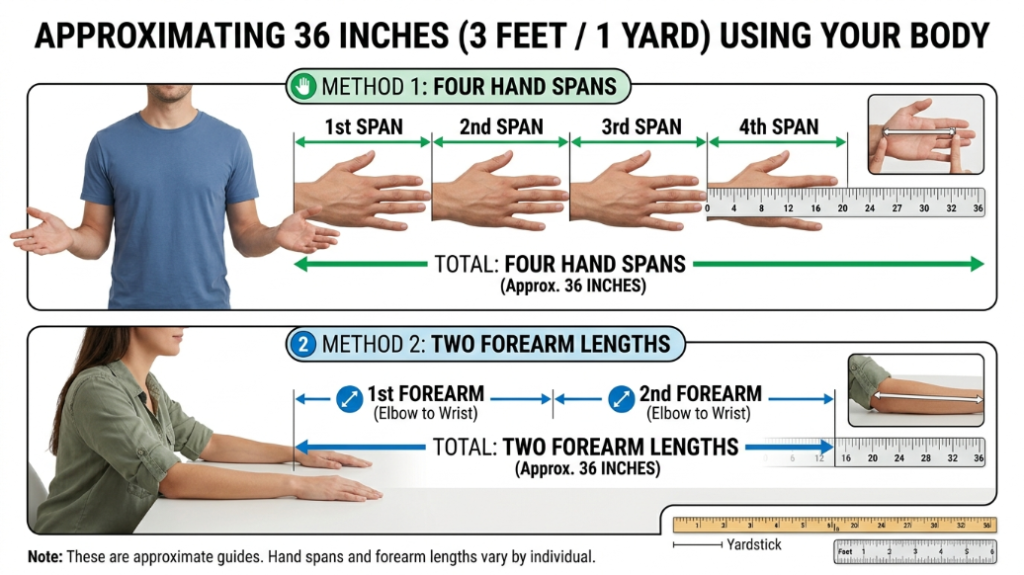
- Roughly four hand spans placed side by side
These comparisons make it easier to estimate 36 inches without needing a measuring tape.
Is 36 Inches Considered Long?
The answer depends on what you’re measuring.
For some objects, 36 inches is fairly large. For others, it’s completely standard.
In Furniture
A 36-inch coffee table is average.
A 36-inch wide cabinet is considered spacious.
A 36-inch desk may be compact.
In Construction
Thirty-six inches is one of the most common dimensions used in homes.
Examples include:
- Countertop heights
- Door widths
- Shower dimensions
- Vanity heights
In Sports Equipment
A 36-inch baseball bat is among the longest legal bats used in organized play.
In Luggage
A 36-inch suitcase is considered very large and may exceed standard airline baggage limits.
So while 36 inches isn’t enormous, it is a significant measurement that appears frequently in everyday products and building standards.
What Does 36 Inches Look Like Compared to Your Body?
One of the easiest ways to estimate measurements is by using your own body as a reference.
Four Average Hand Spans
The average adult hand span from the tip of the thumb to the tip of the little finger when fully stretched is approximately 9 inches.
That means:
- 1 hand span = about 9 inches
- 4 hand spans = about 36 inches
This is a surprisingly accurate estimation method.
Two Forearm Lengths
The average adult forearm measures around 18 inches from elbow to fingertip.
Therefore:
- 1 forearm ≈ 18 inches
- 2 forearms ≈ 36 inches
Builders, carpenters, and DIY enthusiasts often use body measurements for quick estimates when precise tools aren’t available.
Shoulder-to-Waist Comparison
For many adults, the distance from shoulder to upper thigh is close to 36 inches.
Although body proportions vary, this can provide another useful visual cue.
8 Common Things That Are 36 Inches Long
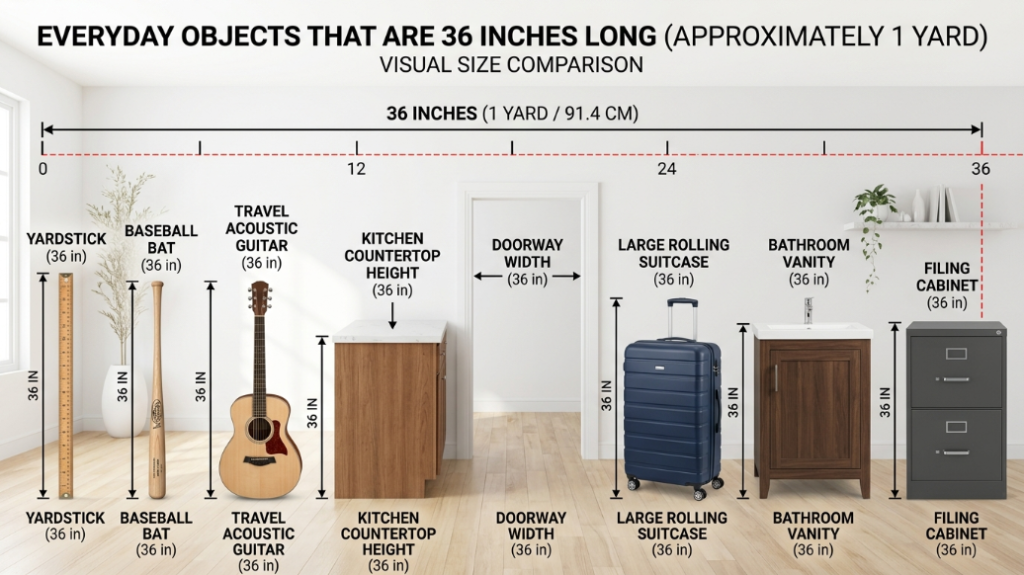
One of the best ways to understand how long 36 inches is involves comparing it to everyday objects.
Standard Yardstick
A yardstick is exactly 36 inches long.
This makes it the most accurate and easiest comparison available.
Yardsticks are commonly used in:
- Schools
- Workshops
- Construction sites
- Sewing and quilting projects
Since the yardstick was designed around the measurement itself, it serves as the perfect visual reference.
Adult Baseball Bat
Many adult baseball bats range between 33 and 36 inches.
According to USA Baseball standards, 36 inches is generally the maximum legal length for most bats.
Because baseball bats are familiar objects, they offer an excellent way to picture this measurement.
If you’ve ever held a full-size bat, you’ve already experienced something very close to 36 inches long.
Small Acoustic Guitar
Many travel guitars and parlor guitars measure approximately 36 inches from end to end.
These compact instruments are designed for portability while maintaining sound quality.
While full-size acoustic guitars are often slightly longer, smaller models frequently fall right around the 36-inch mark.
Kitchen Countertop Height
Most kitchen countertops in American homes stand exactly 36 inches high.
This standard has become universal because it provides a comfortable working height for food preparation.
Whether you’re chopping vegetables, kneading dough, or washing dishes, a 36-inch counter height reduces strain on the back and shoulders.
This dimension is widely recognized by architects, builders, and interior designers.
Standard Accessibility Door Width
Many residential doors measure between 30 and 36 inches wide.
Doorways designed for accessibility frequently use a full 36-inch width.
This allows sufficient clearance for:
- Wheelchairs
- Walkers
- Mobility devices
- Moving furniture
Because of accessibility requirements, 36 inches has become an important standard dimension in modern construction.
Large Rolling Suitcase
Oversized rolling luggage often approaches 36 inches in height.
These large suitcases are typically used for:
- International travel
- Extended vacations
- Family trips
Although most airline-approved luggage is smaller, some checked bags come very close to this measurement.
Bathroom Vanity
Many bathroom vanities are approximately 36 inches high.
Older vanities were often built at 30 to 32 inches.
However, modern “comfort height” vanities frequently use a 36-inch design to improve usability.
This height helps reduce bending while washing hands or brushing teeth.
Three-Drawer Filing Cabinet
Many office filing cabinets stand around 36 inches tall.
These cabinets provide substantial storage while remaining low enough to fit under windows or alongside desks.
If you’ve worked in an office environment, you’ve likely seen filing cabinets close to this height.
Visual Comparison Chart for 36 Inches
The following chart shows how common objects compare to a 36-inch measurement.
| Object | Approximate Size |
|---|---|
| Yardstick | 36 inches |
| Kitchen Countertop | 36 inches |
| Bathroom Vanity | 36 inches |
| Accessibility Door Width | 36 inches |
| Adult Baseball Bat | Up to 36 inches |
| Filing Cabinet | Around 36 inches |
| Travel Guitar | Around 36 inches |
| 3-Year-Old Child | Around 36 inches tall |
These references help create a more intuitive understanding of the dimension.
What Things Are 36 Inches Tall?
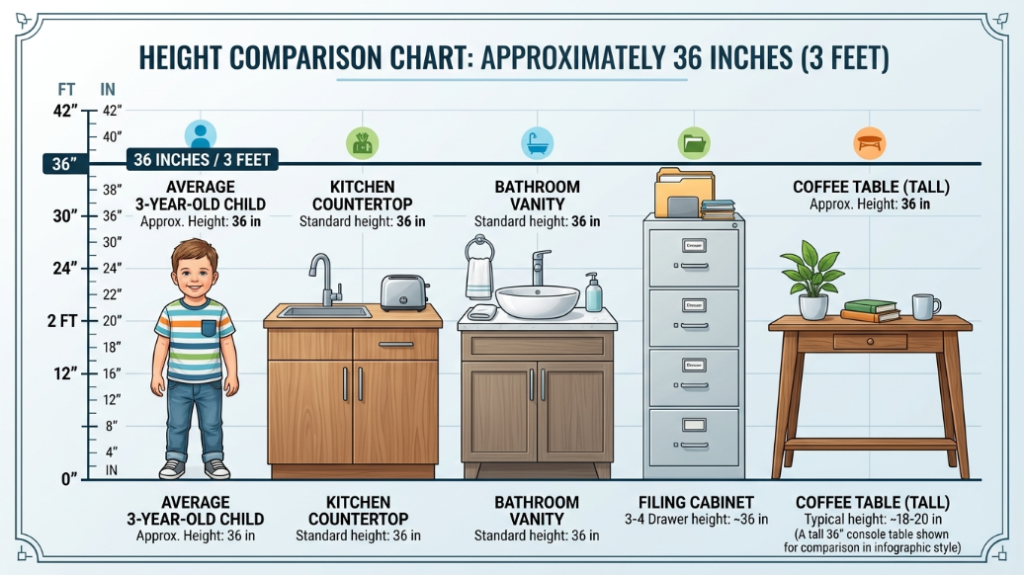
Length and height are often discussed separately, but many objects happen to be 36 inches tall as well.
Average Height of a Three-Year-Old Child
Growth charts published by pediatric organizations show that many children reach approximately 36 inches tall between ages 2½ and 3 years.
This milestone is significant because many amusement parks use 36 inches as a minimum ride height requirement.
Parents often celebrate reaching this benchmark because it opens access to more attractions and activities.
Kitchen Counters
Kitchen counters are among the most recognizable examples of a 36-inch height.
The standard evolved through decades of ergonomic research and building practices.
Most adults can comfortably prepare food at this level without excessive bending.
Bathroom Vanities
Modern bathroom vanities increasingly follow the same 36-inch height standard.
Designers favor this measurement because it improves comfort and accessibility.
Small Filing Cabinets
Office furniture manufacturers commonly design filing cabinets around 36 inches tall.
This height provides useful storage while maintaining accessibility.
Coffee Tables and Storage Furniture
Some larger coffee tables and storage units approach the 36-inch range, especially pieces designed for multifunctional use.
How to Measure 36 Inches Accurately
Accurate measurement is important when purchasing furniture, planning renovations, or building projects.
Using a Tape Measure
The simplest method is a tape measure.
Steps:
- Place the tape at the starting point.
- Extend it until it reaches 36 inches.
- Mark the endpoint.
- Double-check the measurement.
This method provides the highest level of accuracy.
Using a Yardstick
A yardstick is already 36 inches long.
Simply place it against the object or surface you’re measuring.
No calculations are required.
Using Multiple Rulers
If you only have a 12-inch ruler:
- Measure 12 inches three times.
- Add the segments together.
- Total length = 36 inches.
Estimating Without Measuring Tools
If no tools are available, use common references.
Hand Span Method
Four hand spans ≈ 36 inches.
Forearm Method
Two forearm lengths ≈ 36 inches.
Floor Tile Method
Many floor tiles measure 12 inches.
Three tiles in a row equal approximately 36 inches.
Paper Sheet Method
Standard letter paper is 11 inches long.
Three sheets placed end-to-end create a length close to 33 inches, offering a rough estimate.
Why Is 36 Inches Such a Common Measurement?
There is a reason this dimension appears repeatedly throughout daily life.
It Equals One Yard
The yard is one of the oldest standard units still used today.
Historically, the yard became deeply embedded in construction, manufacturing, and commerce.
Because 36 inches equals exactly one yard, many products are designed around this measurement.
Construction Standards
Builders rely heavily on standard dimensions.
Examples include:
- Counter heights
- Door widths
- Cabinet dimensions
- Accessibility requirements
Using consistent measurements simplifies design and construction.
Manufacturing Efficiency
Manufacturers often standardize products around common measurements.
Benefits include:
- Reduced production costs
- Easier installation
- Better compatibility
- Simplified packaging
Thirty-six inches is one of the most practical dimensions for these purposes.
36 Inches Compared to Other Popular Measurements
Comparisons help put measurements into perspective.
24 Inches vs 36 Inches
- 24 inches = 2 feet
- 36 inches = 3 feet
Difference: 12 inches
A 36-inch object is 50% longer than a 24-inch object.
30 Inches vs 36 Inches
- 30 inches = 2.5 feet
- 36 inches = 3 feet
Difference: 6 inches
This difference is noticeable in furniture and cabinetry.
40 Inches vs 36 Inches
- 40 inches = 3.33 feet
- 36 inches = 3 feet
Difference: 4 inches
The two measurements are relatively close.
48 Inches vs 36 Inches
- 48 inches = 4 feet
- 36 inches = 3 feet
Difference: 12 inches
A 48-inch object is one-third longer than a 36-inch object.
Comparison Table
| Measurement | Feet | Common Example |
|---|---|---|
| 24 inches | 2 feet | Coffee table |
| 30 inches | 2.5 feet | Desk height |
| 36 inches | 3 feet | Yardstick |
| 40 inches | 3.33 feet | TV width |
| 48 inches | 4 feet | Bookshelf |
Practical Uses for 36-Inch Measurements
Understanding 36 inches can be surprisingly useful.
Furniture Shopping
When purchasing:
- Tables
- Cabinets
- Dressers
- Shelving
Knowing what 36 inches looks like helps prevent sizing mistakes.
Home Renovation Projects
Many renovations require understanding standard dimensions.
Examples include:
- Installing cabinets
- Building countertops
- Framing doorways
- Planning storage spaces
Interior Design Planning
Designers frequently use 36-inch spacing recommendations.
For example:
Many kitchen design guidelines recommend at least 36 inches of clearance for walkways around islands and work areas.
This creates comfortable movement throughout the room.
Sports Equipment Selection
Baseball bats, hockey equipment, and training gear often use measurements close to 36 inches.
Understanding these dimensions improves purchasing decisions.
Travel and Luggage Planning
Knowing whether luggage approaches 36 inches helps travelers avoid oversize baggage fees.
Fun Facts About 36 Inches
Here are some interesting facts about this common measurement.
- Exactly 1 yard long.
- Equal to 91.44 centimeters.
- Standard kitchen countertop height in the United States.
- Frequently used as an accessibility doorway width.
- Common amusement park height requirement for children.
- Often considered the maximum length for many baseball bats.
- Widely used in furniture manufacturing.
- One of the most recognizable measurements in the imperial system.
Frequently Asked Questions
How long is 36 inches visually?
36 inches looks about as long as a yardstick, a large baseball bat, or the height of a standard kitchen countertop.
Is 36 inches the same as 3 feet?
Yes, 36 inches equals exactly 3 feet or 1 yard.
Is 36 inches 5 feet?
No, 36 inches is 3 feet. Five feet equals 60 inches.
What is 36 inch in cm?
36 inches equals 91.44 centimeters.
Is 36 inches large or XL?
It depends on the context; 36 inches is standard for many items and often Medium to Large in clothing sizes.
What does 38 inches look like?
38 inches is slightly longer than a yardstick and about the length of many full-size acoustic guitars.
Conclusion
Understanding how long 36 inches is becomes much easier when you connect the measurement to real-world objects. While 36 inches equals 3 feet, 1 yard, 91.44 centimeters, or 0.9144 meters, most people find visual comparisons far more useful than simple conversions.
From a standard yardstick and adult baseball bat to kitchen countertops and accessibility doorways, examples of 36-inch dimensions appear throughout everyday life. This measurement has become a cornerstone of construction, furniture design, sports equipment, and household products because it offers a practical balance between size and usability.
The next time you need to estimate 36 inches, remember a simple reference: it’s about the length of a yardstick and the height of a typical kitchen counter. That mental image can make measuring, shopping, and planning projects much easier.