
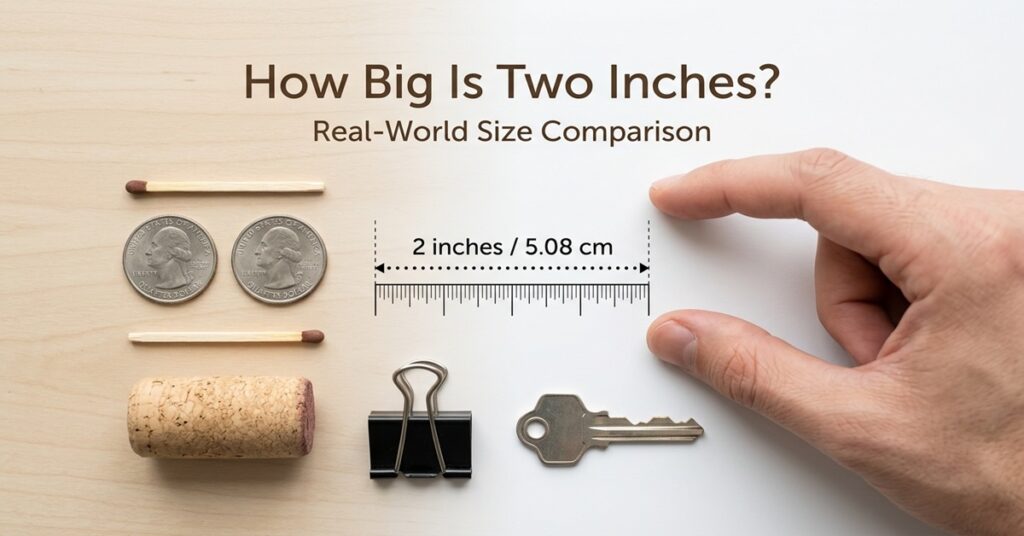

Understanding small measurements like 2 inches sounds easy until you actually need to picture it without a ruler. Most people can recognize a foot or a meter visually, but two inches sits in that tricky middle space: small enough to be underestimated, but large enough to matter in everyday tasks like DIY, crafting, office work, and even cooking.
So, how big is two inches really?
In this guide, we’ll break it down using real objects, body references, conversion data, and practical examples so you can visually recognize two inches instantly anywhere, anytime.
What Does “Two Inches” Actually Mean?
When we talk about how big is two inches, we’re referring to a unit in the imperial measurement system commonly used in the United States.
Basic Conversion of 2 Inches
Here’s what 2 inch equals in other units:
| Unit | Equivalent of 2 Inches |
|---|---|
| Centimeters | 5.08 cm |
| Millimeters | 50.8 mm |
| Meters | 0.0508 m |
| Feet | 0.167 ft |
| Yards | 0.0556 yd |
A simple way to remember it is:
2 inches is just a little over 5 centimeters.
That’s roughly the length of a small household object you can easily hold between your thumb and index finger.
How Big Is Two Inches in Real Life?
Numbers alone don’t help most people visualize size. That’s why real-world comparisons are much more effective.
The Thumb Rule (Most Natural Reference)
For most adults, the width of a thumb is very close to 1 inch. So:
- 2 thumbs side-by-side ≈ 2 inch
This is one of the most widely used informal measurement tricks in carpentry and tailoring because it is always available.
Index Finger Joint Method
Another reliable reference:
- The distance from the fingertip to the first knuckle of an index finger is approximately 2 inches for many adults.
While not perfectly identical for everyone, it remains one of the most practical estimation tools used in everyday life.
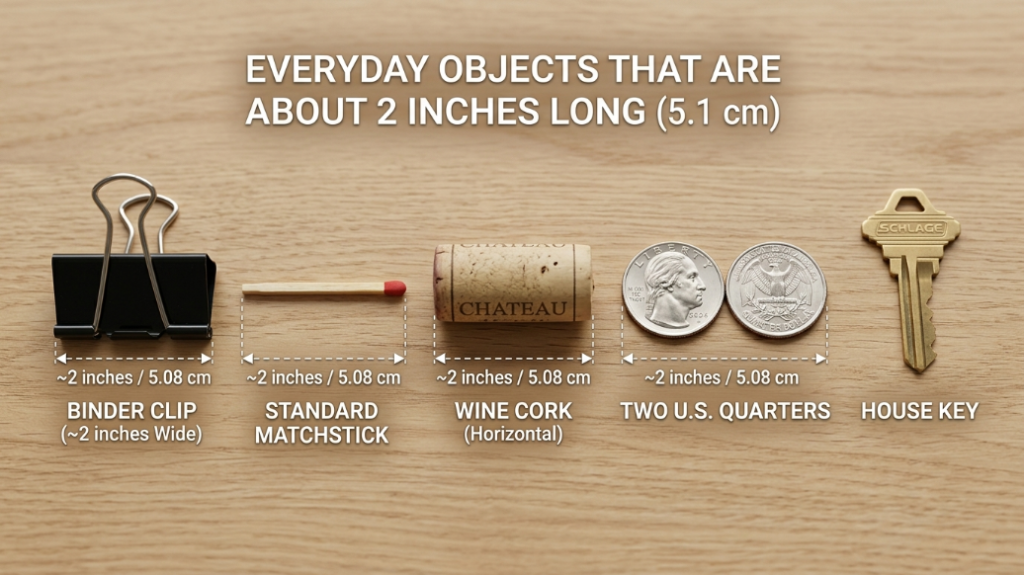
Everyday Objects That Are About 2 Inches Long
One of the best ways to understand how big is 2 inches is to compare it with familiar objects you already see daily.
Large Binder Clip
A standard large binder clip used in offices is often around 2 inches wide across its metal jaws.
These are commonly used in workplaces and schools, including supplies from retailers like Staples and Office Depot.
Why this matters:
- Designed to hold thick paper stacks (often 80–100 pages)
- Built with standardized sizing for consistent grip strength
- One of the most reliable physical references for 2 inch
Two U.S. Quarters Side by Side
A U.S. quarter has a diameter of 0.955 inches, according to the U.S. Mint.
So:
- 2 quarters = 1.91 inch
That’s extremely close to 2 inches, making it a useful pocket measurement tool.
Standard Matchstick
A typical wooden matchstick is close to 2 inches long. Companies like Diamond Match have standardized match lengths for safety and packaging consistency.
Why it’s useful:
- Easy ignition length
- Fits standard matchboxes
- Widely available in households
Wine Cork
A natural wine cork is also close to 2 inches in length.
According to wine education references, cork sizing is standardized to ensure proper sealing in 750 ml bottles. Brands like Wine Enthusiast often reference this measurement in tasting education.
Standard House or Car Key
Most keys used in residential locks (brands like Kwikset or Schlage) have a blade length close to 2 inches.
This is not accidental:
- Ensures smooth insertion into pin tumbler locks
- Balances portability with functional depth
- Standardized across automotive brands like Ford and Toyota keys
Why Two Inches Shows Up Everywhere in Daily Life
You might be surprised how often 2 inches appears in everyday objects.
Office and Work Environments
In workplaces, 2-inch sizing is common in:
- Binder clips
- Heavy-duty paper fasteners
- Stationery accessories
This is partly because manufacturers like ACCO and Avery optimize tools for standard document handling sizes.
Kitchen and Household Items
You’ll also find 2-inch objects in kitchens:
- Matchsticks for stoves and camping
- Wine corks for bottle sealing
- Small utensil components
These are designed for ergonomic handling and compact storage.
Everyday Carry (Pocket Items)
Your pocket likely already contains multiple “2-inch references”:
- Keys
- Coins
- Small tools
This makes 2 inches one of the most unintentionally familiar measurements in daily life.
How to Measure 2 Inches Without a Ruler
If you don’t have a ruler, you can still estimate how big is 2 inches with surprising accuracy.
Method 1 — Thumb Width Estimate
- Place your thumb on a surface
- Measure its width visually
- Add a second thumb for a rough 2-inch span
This method is widely used in quick field estimation.
Method 2 — Finger Joint Technique
- Place your index finger flat
- Measure from fingertip to first knuckle
This method is often more consistent than thumb width.
Method 3 — Coin Reference
- Two U.S. quarters ≈ 1.91 inches
This is one of the closest standardized everyday references available.
Method 4 — Object-Based Estimation
You can also use:
- Binder clips
- Matchsticks
- Key blades
These are especially helpful in office or home environments.
Accuracy Comparison Table (Practical Guide)
| Method | Accuracy | Best Use Case |
|---|---|---|
| Index finger joint | ★★★★★ | Fast body estimation |
| Thumb width | ★★★★☆ | General reference |
| Two quarters | ★★★★☆ | Coin-based measurement |
| Binder clip | ★★★★☆ | Office environment |
| Matchstick | ★★★☆☆ | Kitchen/camping |
Why Humans Struggle to Visualize 2 Inches
Understanding how big is two inches is not just about measurement it’s also about perception.
Cognitive Size Distortion
Humans naturally struggle with small-scale estimation because:
- We lack internal “rulers” for small units
- Objects look different depending on context
- Visual memory prioritizes larger scales
Context Changes Perception
Two inches can look:
- Large on a phone screen
- Small on a desk
- Medium in hand
This is called context-based scaling, and it affects how we interpret size daily.
Why Professionals Use Body-Based Measurement Systems
Before rulers and digital tools, professionals relied heavily on body-based measurement systems.
Examples include:
- Carpenters using hand spans
- Tailors using finger widths
- Jewelers using knuckle measurements
Even today, these methods remain relevant because they are:
- Always available
- Consistent enough for rough work
- Fast and practical
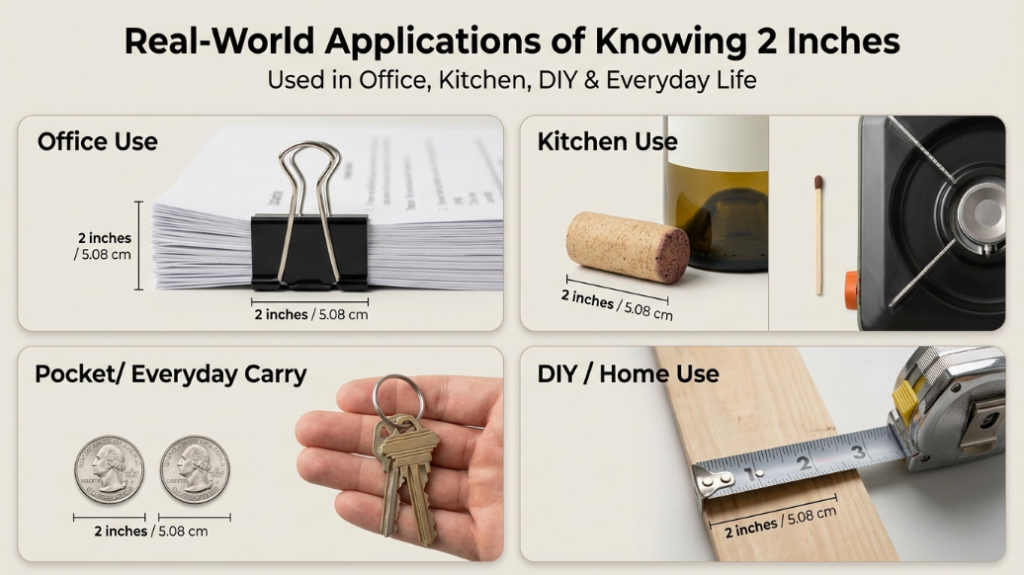
Real-World Applications of Knowing 2 Inches
Understanding this measurement is more useful than it seems.
DIY and Home Repairs
You might use 2 inch when:
- Spacing screws
- Measuring gaps
- Aligning fixtures
Crafting and Design
Artists and designers rely on small measurements for:
- Proportions
- Layout balance
- Precision cutting
Office Work
Common applications include:
- Organizing documents
- Clip selection
- Folder spacing
Everyday Problem Solving
Even outside technical fields:
- Estimating object sizes
- Packing items
- Quick visual checks
2 Inches vs Other Common Measurements
To better understand scale:
- 1 inch = very small (finger segment)
- 2 inch = small object size (key, cork)
- 3 inch = noticeable handheld object
This progression helps train visual estimation skills over time.
Expert Insight: Why So Many Objects Are Around 2 Inch
Manufacturers often design items around this size because it is:
- Ergonomically comfortable
- Easy to grip
- Efficient for packaging
- Suitable for mechanical functionality
For example:
- Keys must be long enough for lock engagement
- Corks must compress properly inside bottles
- Clips must hold paper securely
This explains why 2 inches appears so frequently in engineered objects.
Frequently Asked Questions (FAQ)
How big is 2 inches visually?
It is roughly the width of a thumb or the length of a wine cork small but clearly visible.
What objects are 2 inches long?
Common examples include:
- Binder clips
- Matchsticks
- Keys
- Wine corks
- Two quarters side by side
How can I measure 2 inches without a ruler?
Use your index finger joint, thumb width, or two coins placed side by side.
Is 2 inches equal to 5 cm?
Yes. 2 inches equals 5.08 centimeters.
Why is 2 inches a useful measurement?
Because it appears frequently in everyday objects, making it easy to estimate visually.
Final Thoughts: Understanding Two Inches in Everyday Life
So, how big is two inches?
It’s small enough to fit in your palm, but large enough to appear in dozens of everyday objects from keys and corks to binder clips and coins.
Once you train your eye to recognize it using body references or common objects, you’ll start noticing it everywhere. That simple awareness can make DIY tasks easier, improve estimation skills, and help you navigate everyday measurements with confidence.
In short, two inches is one of the most practically useful “small measurements” in daily life even if you never notice it.