
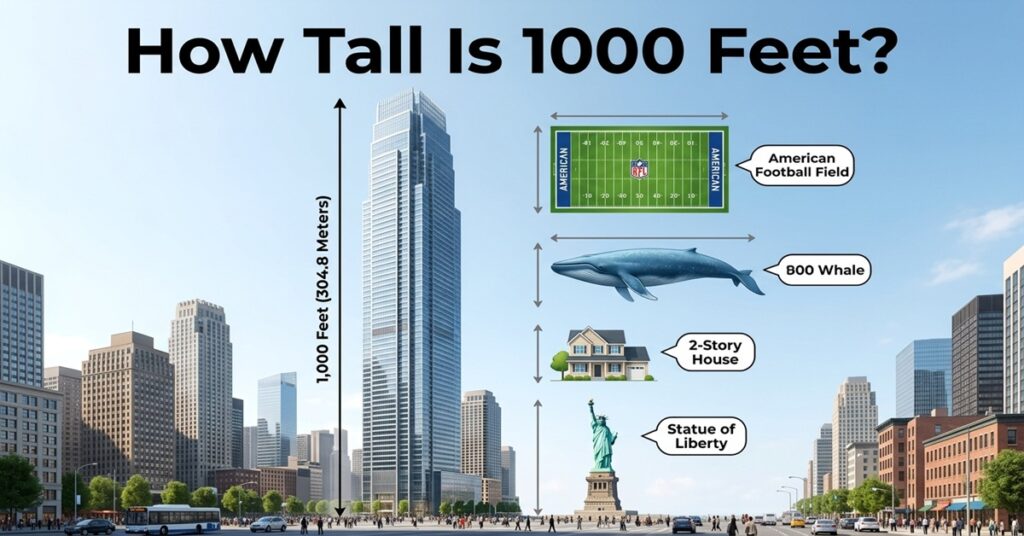

Understanding how tall 1000 feet is can be surprisingly difficult. Most people rarely encounter structures, cliffs, or landmarks that reach this height, making it hard to visualize in everyday life.
To put it simply, 1000 feet is equal to 304.8 meters, roughly the height of a 90- to 100-story skyscraper. It is also more than three football fields stacked vertically and significantly taller than many famous landmarks around the world.
Whether you’re curious about building heights, comparing measurements, or trying to understand what 1000 feet looks like in real life, this guide breaks it down with practical examples, comparisons, and fascinating facts.
How Tall Is 1000 Feet?
One thousand feet is a substantial height that places a structure firmly in the skyscraper category.
For perspective, many buildings people consider “tall” range between 300 and 600 feet. A 1000-foot building towers above most city skylines and becomes a defining feature of the landscape.
1000 Feet at a Glance
| Measurement | Equivalent |
|---|---|
| Feet | 1,000 ft |
| Meters | 304.8 m |
| Yards | 333.33 yd |
| Inches | 12,000 in |
| Kilometers | 0.3048 km |
| Miles | 0.189 mi |
These conversions help show just how significant 1000 feet is. While it is less than a quarter mile, vertically it represents a tremendous height.
Why 1000 Feet Is Considered Significant
Architects and engineers often view the 1000-foot mark as an important milestone. Buildings exceeding this height are usually classified as supertall skyscrapers or approach that category.
Crossing the 1000-foot threshold requires advanced engineering, stronger materials, and sophisticated systems to withstand wind forces and support thousands of occupants.
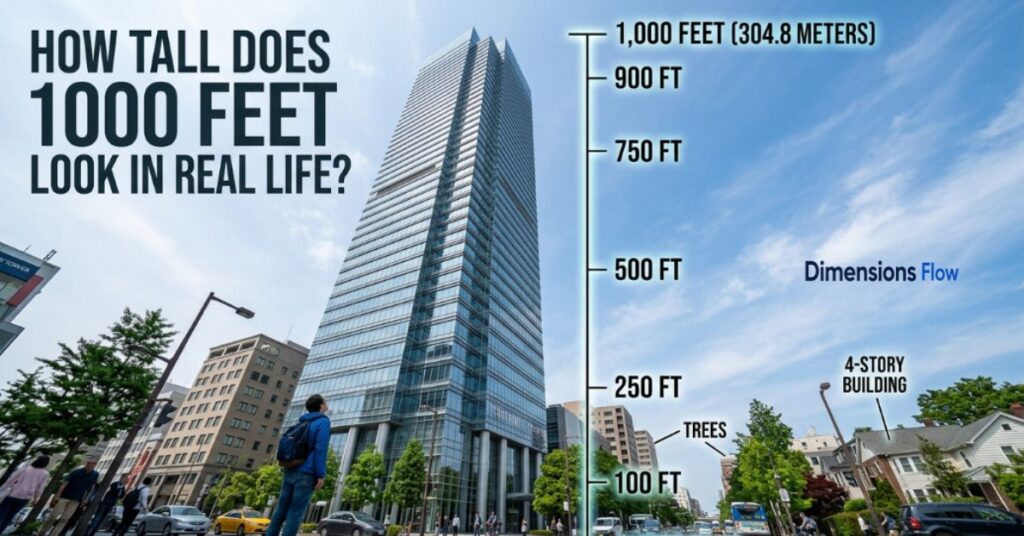
How Tall Does 1000 Feet Look in Real Life?
Visualizing 1000 feet isn’t easy because most everyday objects are much smaller.
A two-story house is generally around 20 to 25 feet tall. That means a 1000-foot structure would be approximately 40 to 50 times taller than a typical home.
Why Most People Underestimate 1000 Feet
Human perception struggles with large vertical distances.
Several factors contribute to this:
- Buildings appear smaller from a distance.
- The sky provides no clear reference points.
- Height is harder to judge than horizontal distance.
- Tall structures often taper toward the top, creating an illusion of reduced size.
As a result, many people underestimate how tall 1000 feet actually is.
What Standing Next to a 1000-Foot Structure Feels Like
Standing at the base of a 1000-foot skyscraper can feel overwhelming.
The top may seem almost disconnected from the ground, especially when viewed from directly below. On clear days, looking upward often requires tilting your head nearly vertically to see the building’s peak.
Many visitors to observation decks around the 1000-foot level report that cars below appear toy-sized and pedestrians become difficult to distinguish.
How Many Stories Is 1000 Feet?
One of the easiest ways to understand how tall 1000 feet is involves converting it into building stories.
Average Height of a Building Floor
The height of each floor depends on the building’s purpose.
Typical averages include:
| Building Type | Average Floor Height |
|---|---|
| Residential | 10–12 feet |
| Office | 12–15 feet |
| Luxury Commercial | 14–18 feet |
How Many Floors Equal 1000 Feet?
Using standard floor heights:
- Residential tower: 83–100 stories
- Office building: 67–83 stories
- Mixed-use skyscraper: 75–95 stories
This is why many sources compare 1000 feet to a 90- to 100-story building.
Why Story Counts Vary
Not every floor has the same height.
Additional space is often needed for:
- Mechanical equipment
- Elevator systems
- Observation decks
- Decorative crowns
- Rooftop structures
Because of these differences, two buildings with the same height may have different numbers of stories.
Famous Buildings That Are Around 1000 Feet Tall
Looking at real structures helps make the concept easier to understand.
The Shard
The Shard rises approximately 1,016 feet (310 meters) above London.
Completed in 2012, it remains one of Europe’s most recognizable skyscrapers. Designed by Renzo Piano, its glass-covered exterior resembles a shard of crystal emerging from the city skyline.
Its height is remarkably close to 1000 feet, making it an excellent reference point.
Empire State Building
The Empire State Building’s famous observatory sits around 1,050 feet above street level.
For decades after its completion in 1931, it was the tallest building in the world.
Visitors standing on the observation deck experience a height only about 50 feet greater than 1000 feet.
Other Buildings Near the 1000-Foot Mark
Many modern skyscrapers approach or exceed 1000 feet, including:
- Luxury residential towers
- Corporate headquarters
- Mixed-use developments
- Observation towers
These structures often become defining landmarks within their cities.
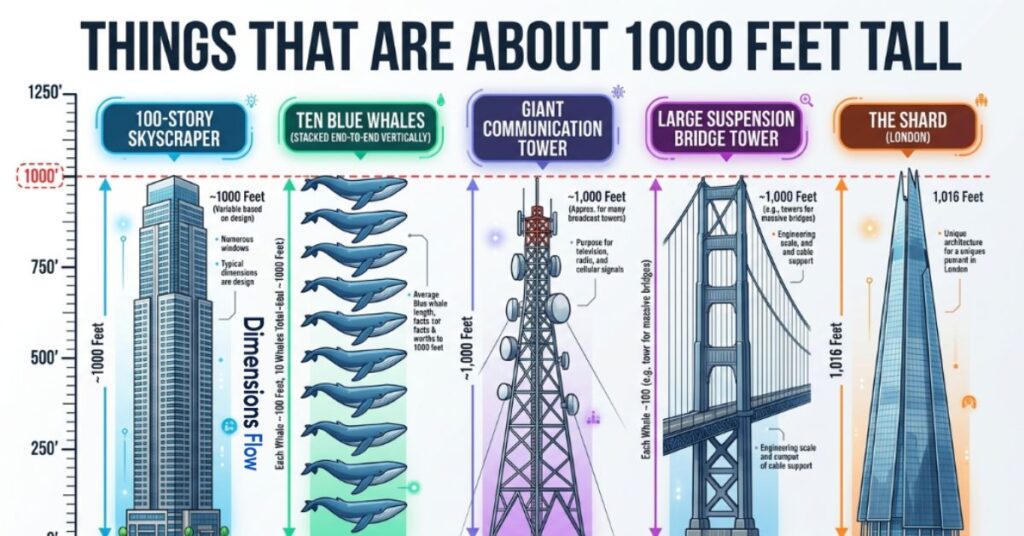
Things That Are About 1000 Feet Tall
Comparisons make measurements easier to understand.
Here are several real-world examples that closely match 1000 feet.
A 100-Story Building
Many 100-story skyscrapers stand near the 1000-foot mark.
Although exact heights vary, this remains one of the most accurate visual references.
Three Football Fields Stacked Vertically
A standard American football field measures 360 feet long including end zones.
Three fields stacked vertically equal:
360 × 3 = 1,080 feet
That’s only slightly taller than 1000 feet.
Ten Blue Whales Stacked End to End
The largest blue whales can grow close to 100 feet long.
Ten of these giants lined up vertically would create a length of approximately 1000 feet.
Large Communication Towers
Many broadcasting towers and communications structures exceed 1000 feet.
These towers are often visible from many miles away because of their extreme height.
Observation Towers
Observation towers around the world frequently approach or surpass 1000 feet, providing visitors with expansive views of surrounding landscapes.
10 Real-Life Comparisons to Help You Visualize 1000 Feet
1. Nearly Three Football Fields
A football field is a familiar reference point. Three football fields placed end to end are slightly longer than 1000 feet.
2. A Skyscraper Near 100 Stories
This is perhaps the most common comparison used by architects and urban planners.
3. A 90-Second Elevator Ride
High-speed elevators traveling to observation decks around 1000 feet often complete the journey in under two minutes.
4. A Major Suspension Bridge Tower
Some bridge towers reach heights approaching or exceeding 1000 feet.
5. A Cruise Ship Standing Upright
Many large cruise ships measure between 900 and 1200 feet long.
If positioned vertically, they would closely match the 1000-foot mark.
6. Ten Blue Whales
The world’s largest animal offers a memorable comparison.
7. A Mountain Cliff
Some canyon walls and coastal cliffs rise approximately 1000 feet above surrounding terrain.
8. More Than 40 Typical Houses
Stacking 40 average two-story homes would roughly equal 1000 feet.
9. A Giant Wind Turbine
Modern offshore wind turbines can exceed 850 feet in total height, approaching the 1000-foot benchmark.
10. An Urban Skyline Landmark
Buildings near 1000 feet often dominate city skylines and can be seen from great distances.
How Long Would It Take to Reach 1000 Feet High?
Height can also be understood through travel time.
Walking Up Stairs to 1000 Feet
A typical stair step rises about 7 inches.
To climb 1000 feet:
- Total height = 12,000 inches
- 12,000 ÷ 7 ≈ 1,714 steps
That’s more than many people climb in an entire week.
Taking an Elevator
Modern skyscraper elevators often travel between 1,000 and 2,000 feet per minute.
At those speeds, reaching 1000 feet may take less than one minute.
Hiking a 1000-Foot Elevation Gain
Hikers frequently measure trails by elevation gain.
A climb of 1000 feet is generally considered moderate and can take anywhere from 30 minutes to several hours depending on terrain and fitness level.
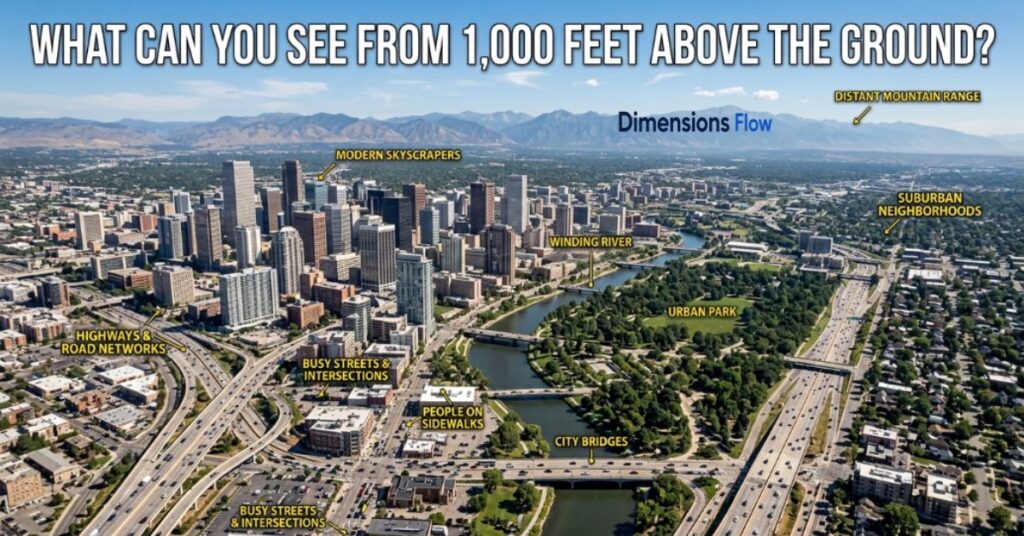
What Can You See From 1000 Feet Above the Ground?
One of the most fascinating aspects of reaching 1000 feet is the view.
Visibility on a Clear Day
The horizon becomes dramatically wider as elevation increases.
At approximately 1000 feet, the theoretical horizon can extend more than 38 miles away under ideal conditions.
City Views
Observation decks around the 1000-foot level provide:
- Panoramic skyline views
- River and coastline visibility
- Major landmarks
- Detailed city layouts
Landscape Perspective
From this height, geographic features become easier to appreciate.
You can often observe:
- Mountain ranges
- Forest patterns
- Road networks
- Waterfronts
- Urban development
A Completely Different Scale
At ground level, city blocks feel large.
From 1000 feet above, entire neighborhoods can appear compact and interconnected.
Is 1000 Feet Considered Tall?
The short answer is yes.
In fact, 1000 feet is exceptionally tall.
Compared to Average Buildings
Most commercial buildings range from 50 to 200 feet tall.
A 1000-foot structure is five to twenty times taller.
Compared to Modern Skyscrapers
While some modern supertall towers exceed 1500 feet, buildings around 1000 feet still rank among the tallest structures in most cities.
Why Architects Value the 1000-Foot Mark
Crossing 1000 feet often signifies:
- Engineering excellence
- Economic investment
- Urban prestige
- Advanced construction technology
Many cities celebrate the completion of their first 1000-foot building as a historic milestone.
“Height has always represented ambition in architecture, and the 1000-foot mark remains one of the industry’s most recognized achievements.”
1000 Feet vs Other Common Heights
Understanding relative scale makes visualization easier.
Height Comparison Table
| Height | Real-World Example |
|---|---|
| 100 ft | Small office building |
| 300 ft | Large tower |
| 500 ft | Mid-size skyscraper |
| 1000 ft | 90–100 story skyscraper |
| 1500 ft | Supertall skyscraper |
| 2000 ft | Mega-tall tower |
100 Feet vs 1000 Feet
A 1000-foot structure is ten times taller.
300 Feet vs 1000 Feet
Many recognizable towers stand around 300 feet tall, yet they are less than one-third the height of 1000 feet.
500 Feet vs 1000 Feet
A 500-foot building appears impressive until placed beside a 1000-foot skyscraper.
1500 Feet vs 1000 Feet
At 1500 feet, buildings enter the upper tier of global skyscraper rankings.
2000 Feet vs 1000 Feet
Only a handful of structures worldwide exceed 2000 feet.
Even so, 1000 feet remains an extraordinary height.
Interesting Facts About 1000 Feet
The Rise of 1000-Foot Skyscrapers
The number of buildings exceeding 1000 feet has increased dramatically since the early 2000s.
Advances in materials, engineering software, and construction techniques have made such projects more feasible.
Wind Becomes a Major Challenge
At heights near 1000 feet, wind forces increase significantly.
Engineers use:
- Tuned mass dampers
- Reinforced cores
- Aerodynamic building shapes
These features reduce movement and improve occupant comfort.
Elevator Technology Matters
Traditional elevator systems become less practical as buildings grow taller.
Modern skyscrapers often rely on advanced elevator technology to move thousands of people efficiently.
Lightning Strikes Are More Common
Buildings around 1000 feet frequently experience lightning strikes.
Most incorporate specialized grounding systems to safely redirect electrical energy.
Birds Fly Below This Height
Many migratory birds fly well below 1000 feet during portions of their journeys, demonstrating just how high this elevation is relative to everyday life.
Frequently Asked Questions
What does 1000 feet compare to?
1,000 feet is about the height of a 90–100 story skyscraper or nearly three football fields stacked vertically.
How tall is 1000 feet visually?
Visually, 1,000 feet looks like a towering skyscraper that dominates a city skyline and can be seen from miles away.
How many floors up is 1000 feet?
A 1,000-foot building typically has about 80–100 floors, depending on ceiling heights and building design.
Is a football field 1000 feet?
No, a standard football field is 360 feet long including end zones, so 1,000 feet is nearly three football fields.
What does a 1000 ft look like?
It looks similar to a major skyscraper, a large observation tower, or ten blue whales lined up end to end.
How far is 1000 feet to walk?
Walking 1,000 feet takes about 4 minutes at an average pace and is roughly equal to 3–4 city blocks.
Conclusion
So, how tall is 1000 feet?
The answer is 304.8 meters, roughly the height of a 90- to 100-story skyscraper. It is taller than three stacked football fields, more than three times the height of the Statue of Liberty, and close to the height of famous landmarks like the Shard and the Empire State Building’s observation deck.
Whether you’re comparing building heights, visualizing elevation, or simply satisfying your curiosity, 1000 feet represents a truly impressive scale. From towering skyscrapers to breathtaking observation decks, it remains one of the most recognizable milestones in architecture and engineering.