
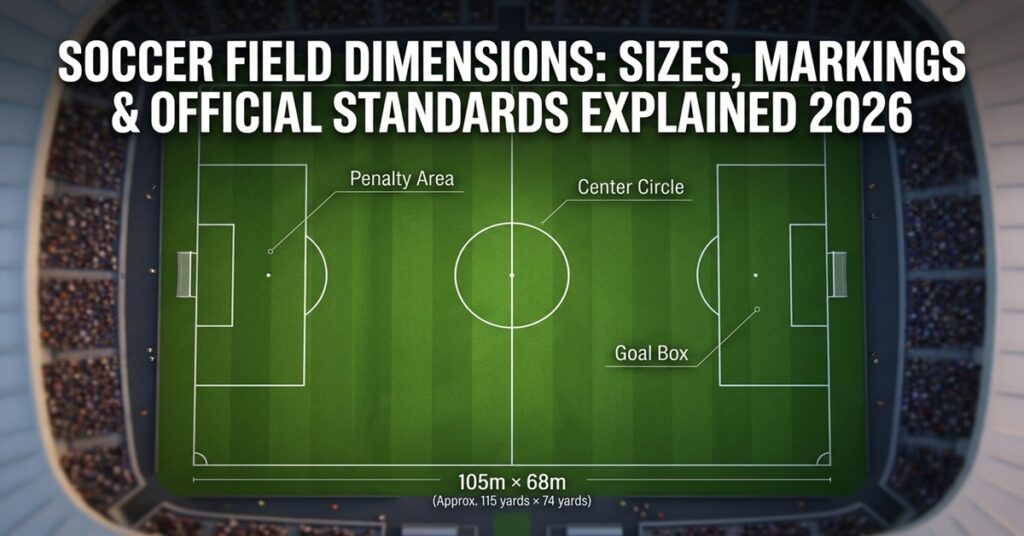

Understanding soccer field dimensions is essential for anyone involved in the game, from players and coaches to fans and facility planners. A soccer pitch is not a fixed-size surface; instead, it follows regulated standards set by governing bodies like FIFA and UEFA.
These rules define how long and wide a field can be, ensuring fairness while still allowing flexibility for different stadiums and levels of play. The most commonly used soccer field size in professional football is 105 × 68 meters, but variations exist across leagues, youth levels, and international competitions.
These differences can influence tactics, spacing, and overall match intensity. In this guide, we break down official soccer field dimensions, markings, and real-world examples from stadiums around the world. Whether you’re learning the basics or analyzing professional pitch standards, this article will help you clearly understand how field size shapes the beautiful game and its global consistency today.
Facts Table:
| Category | Dimension / Rule | Details / Notes |
|---|---|---|
| FIFA Standard Range | 100–110 m × 64–75 m | Used for international matches |
| Most Common Professional Size | 105 m × 68 m | Global benchmark (World Cup, top leagues) |
| UEFA Standard | 105 m × 68 m | Fixed for Champions League & Europa League |
| Premier League Pitch Size | Varies (within FIFA range) | Most close to 105 × 68 m |
| MLS Pitch Size | Varies by stadium | Built within FIFA allowed range |
| Youth U6–U8 | 25–35 yd × 15–25 yd | Small-sided games (4v4 / 5v5) |
| Youth U9–U12 | 70–80 yd × 45–55 yd | 7v7 / 9v9 development stage |
| High School (NFHS) | 110–120 yd × 65–75 yd | Transition to full-size play |
| NCAA College Soccer | 115–120 yd × 70–75 yd | Close to professional level |
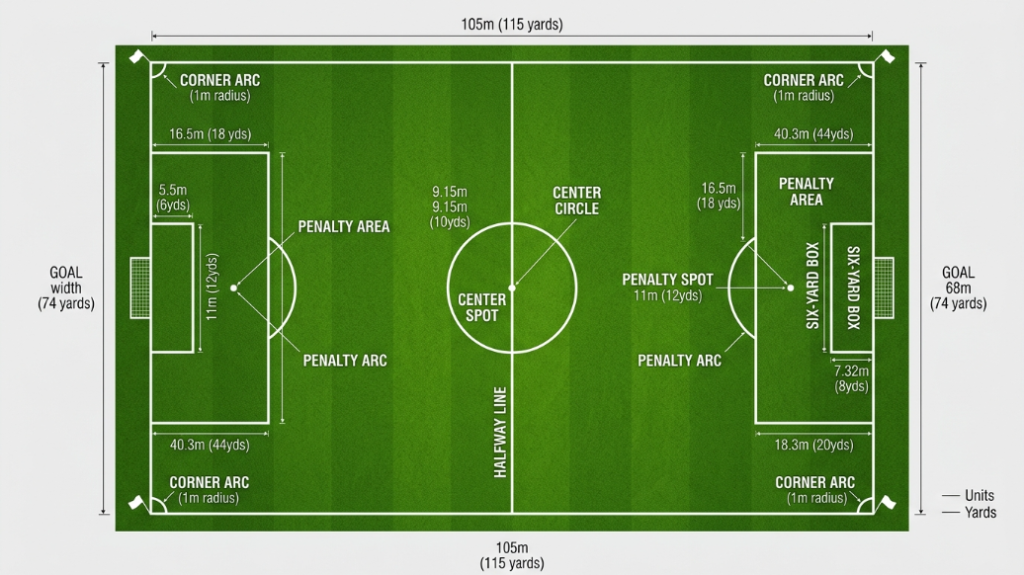
| Penalty Area | 16.5 m (18 yd) depth × 40.3 m width | Goalkeeper handling zone |
| Penalty Spot | 11 m (12 yd) from goal line | Standard penalty kick distance |
| Center Circle | Radius 9.15 m (10 yd) | Kickoff restriction zone |
| Corner Arc | Radius 1 m (1 yd) | Corner kick placement zone |
| Six-Yard Box | 5.5 m (6 yd) × 18.3 m | Goal area for goal kicks |
| Line Width | ~12 cm (5 inches) | Applies to all field markings |
| Total Field Area | ~7,140 m² | Approx. 1.76 acres |
| Safety Buffer Zone | 5–10 m extra space | Outside boundary lines |
| Most Common Conversion | 105 m ≈ 115 yd | Standard pro field length |
| Max FIFA Field Length | 120 m | Upper limit for international play |
| Min FIFA Field Width | 64 m | Lower bound for international matches |
What Is a Standard Soccer Field Size?
A “standard” soccer field is not a single fixed size. Instead, it falls within a regulated range defined by official governing bodies. This flexibility allows stadiums to adapt to available space while still maintaining fair play.
Official Standard Range
According to international rules:
- Length: 100 to 130 yards (90 to 120 meters)
- Width: 50 to 100 yards (45 to 90 meters)
However, professional matches rarely use the full range. Instead, most high-level games follow tighter standards for consistency.
Why There Is a Range Instead of a Fixed Size
The flexibility exists for several practical reasons:
- Older stadium designs vary in space availability
- Grassroots and amateur fields must adapt to local infrastructure
- Tactical diversity is encouraged at lower levels
- Professional consistency is maintained through stricter guidelines
This balance ensures the sport remains global, accessible, and adaptable.
FIFA Soccer Field Dimensions (Professional Standard)
At the highest level of football, regulations become much stricter.
International Match Requirements
For international competitions, the standard pitch size is:
- Length: 100–110 meters
- Width: 64–75 meters
This range is enforced for official international matches to ensure fairness and consistency.
The Most Common Professional Size
The widely accepted elite standard is:
- 105 meters × 68 meters
(Approximately 115 × 74 yards)
This is the dimension used in major tournaments, including the World Cup and Champions League-level matches.
Why 105 × 68 Meters Became the Global Benchmark
This size is considered optimal because it:
- Supports balanced attacking and defensive play
- Provides enough width for wing-based tactics
- Maintains compact defensive structure
- Works well for broadcast camera angles
- Ensures consistent player conditioning demands
Most modern stadiums are built around this specification.
UEFA, Premier League & Domestic League Variations
Even at elite levels, not every league uses identical pitch sizes.
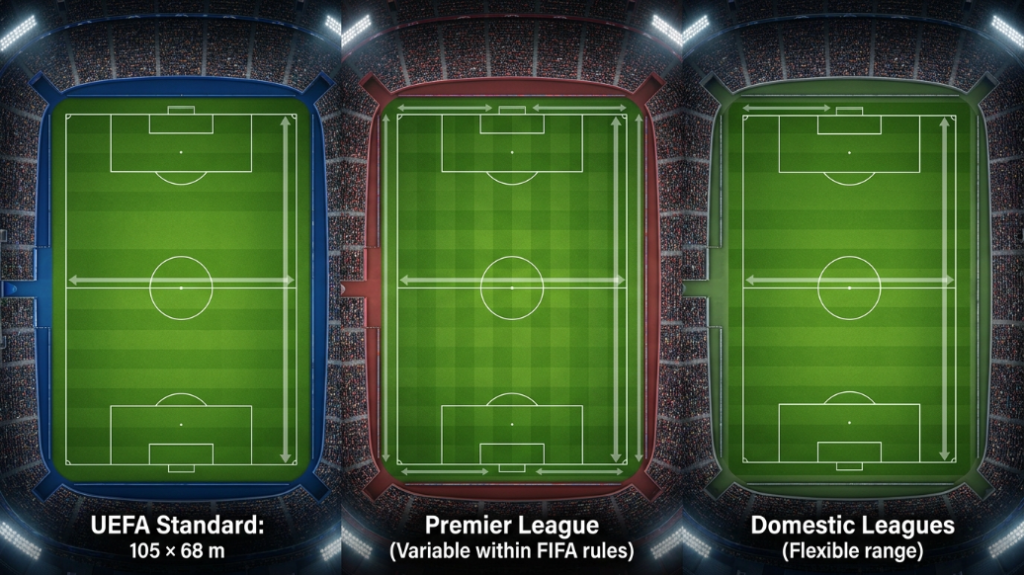
UEFA Standard Requirements
In top European competitions, fields are standardized at:
- 105 × 68 meters
This is used in tournaments like the Champions League to ensure uniform playing conditions across countries.
Premier League Pitch Differences
The Premier League allows limited variation within FIFA rules. Some examples:
- Manchester City (Etihad Stadium): approx. 105 × 68 m
- Liverpool (Anfield): slightly narrower but within regulation
- Other stadiums: small variations depending on design
These subtle differences can influence playing style, especially for teams that rely heavily on width or compact defense.
MLS and Other Leagues
Major League Soccer (MLS) also follows FIFA ranges but allows stadium-based adjustments:
- Some stadiums favor wider pitches for attacking play
- Others use narrower fields for defensive structure
Even a 2–3 meter difference can affect match tempo.
Soccer Field Dimensions in Yards vs Meters (Conversion Guide)
Since soccer is a global sport, both metric and imperial units are used.
Key Conversions Used in Football
| Meters | Yards | Meaning |
|---|---|---|
| 105 m | 115 yd | Standard professional length |
| 68 m | 74 yd | Standard professional width |
| 100 m | 109 yd | Minimum international length |
| 120 m | 131 yd | Maximum international length |
| 64 m | 70 yd | Minimum width (international) |
Why Conversion Matters
Accurate conversions are essential for:
- Stadium construction planning
- Coaching and tactical analysis
- Broadcasting and commentary
- Youth field development
A small miscalculation can change gameplay balance significantly.
Soccer Field Markings and Their Exact Measurements
A soccer field is defined not just by size, but also by precise markings that structure the game.
Boundary Lines (Touchlines & Goal Lines)
- Touchlines run along the length of the field
- Goal lines mark each end of the pitch
- Line width: approximately 12 cm (5 inches)
These lines determine whether the ball is in or out of play.
Center Circle and Halfway Line
- Center circle radius: 9.15 meters (10 yards)
- Halfway line divides the field into two equal halves
- Opponents must remain outside the circle during kickoff
This ensures fair restarts and spacing control.
Penalty Area (18-Yard Box)
One of the most important zones in football.
- Extends 16.5 meters (18 yards) from the goal line
- 40.3 meters wide
- Goalkeeper can use hands only inside this area
This zone defines most defensive and attacking decisions near goal.
Penalty Spot and Arc
- Penalty spot distance: 11 meters (12 yards)
- Penalty arc radius: 9.15 meters
The arc ensures players stay outside the penalty area during a penalty kick.
Six-Yard Box (Goal Area)
- Depth: 5.5 meters (6 yards)
- Width: 18.32 meters
This area is crucial for:
- Goal kicks
- Defensive clearances
- Close-range goalmouth situations
Corner Arcs
- Radius: 1 yard (1 meter)
- Corner flags: minimum 1.5 meters tall
Corner arcs define where the ball is placed during corner kicks.
Why Soccer Fields Are Not All the Same Size
Unlike many sports with fixed court sizes, soccer allows flexibility.
Tactical Influence of Pitch Size
Coaches often adjust tactics based on field dimensions:
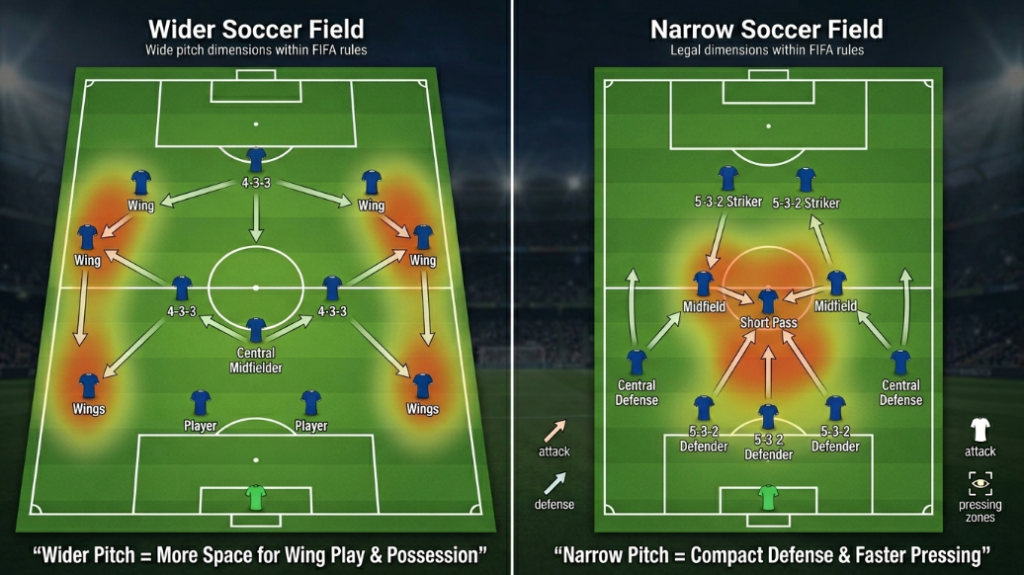
- Wider fields → favor wing play and crosses
- Narrow fields → favor compact defense and pressing
- Longer fields → increase endurance demands
Even small changes affect match rhythm.
Real Tactical Example
- Teams with possession-based systems prefer wider pitches
- Defensive teams often choose narrower setups to reduce space
This subtle strategic layer is often overlooked by casual viewers.
Soccer Field Sizes by Age and Competition Level
Field size evolves as players develop physically and tactically.
Youth Soccer (U6–U8)
- 25–35 yards long
- 15–25 yards wide
- Small-sided games (4v4 or 5v5)
- No offside rule
Focus: basic skill development and enjoyment
Youth Development (U9–U12)
- 70–80 yards long
- 45–55 yards wide
- 7v7 or 9v9 formats
Focus: positioning and spatial awareness
High School Soccer
- 110–120 yards long
- 65–75 yards wide
Focus: transition to full tactical awareness
College Soccer (NCAA Standard)
- 115–120 yards long
- 70–75 yards wide
This closely mirrors professional standards, preparing athletes for elite competition.
Professional Soccer
- Standard: 105 × 68 meters
- Minor variations depending on stadium design
At this level, even 1–2 meters can subtly affect gameplay flow.
FIFA vs UEFA vs Domestic Leagues: Key Differences
While the sport is globally unified, differences still exist in regulation enforcement.
FIFA (Global Authority)
- Sets the overall range
- Allows flexibility for domestic leagues
- Defines international match standards
UEFA (European Competitions)
- Strict standard: 105 × 68 meters
- Used in Champions League and Europa League
Domestic Leagues
- Allow slight variation within FIFA rules
- Stadium-based adaptations are common
This structure maintains global consistency while preserving local identity.
How Soccer Field Dimensions Affect Strategy
Pitch size is not just technical it is deeply tactical.
1. Space Utilization
- Larger fields create more passing lanes
- Smaller fields compress gameplay
2. Player Fitness
- Bigger fields increase total distance covered
- Players must manage stamina more carefully
3. Formation Adjustments
Coaches may adapt formations such as:
- 4-3-3 on wider pitches
- 4-4-2 on narrower pitches
- 3-5-2 for midfield control
4. Pressing Systems
High pressing becomes more effective on smaller pitches due to reduced space.
Soccer Field Area & Safety Specifications
Total Playing Area
A full-size pitch typically covers:
- ~7,140 square meters
- Approximately 1.76 acres
This is significantly larger than many people expect.
Safety Margins
Professional stadiums also include:
- 5–10 meters of extra space beyond boundary lines
- Designed for player safety and ball recovery
These margins are essential for preventing injuries during high-speed play.
Common Misconceptions About Soccer Field Dimensions
“All soccer fields are the same size”
Incorrect. FIFA allows a range, and stadiums vary within it.
“Soccer fields are 200 meters long”
False. Even maximum length is around 120 meters.
“Field size doesn’t affect gameplay”
Wrong. It directly influences tactics, spacing, and physical demand.
“Ball size and field size are related”
Incorrect. Ball size is standardized separately and does not depend on pitch dimensions.
Quick Reference: Soccer Field Dimensions Summary
| Category | Dimensions |
|---|---|
| FIFA Standard | 100–110 m × 64–75 m |
| Most Common Pro Size | 105 × 68 m |
| Youth U6–U8 | 25–35 × 15–25 yards |
| High School | 110–120 × 65–75 yards |
| NCAA College | 115–120 × 70–75 yards |
Frequently Asked Questions (FAQ)
Is a soccer field 100 meters?
No, a soccer field is not fixed at 100 meters.
It usually ranges from 100–110 meters for international matches.
What size is the Premier League field?
Premier League pitches vary by stadium but stay within FIFA rules.
Most are around 105 × 68 meters, the global professional standard.
What is the 80/20 rule in soccer?
The 80/20 rule suggests teams keep possession about 80% in safe areas and attack 20% in final zones.
It emphasizes control, patience, and smart attacking decisions.
What is the size of the FIFA football field?
FIFA allows a range of 100–110 meters long and 64–75 meters wide for international matches.
The most common professional size is 105 × 68 meters.
Is a soccer field 20 meters long?
No, that is far too small for soccer.
Even youth fields are much larger, and professional pitches start around 100 meters in length.
Conclusion
In conclusion, soccer field dimensions play a much deeper role in football than most people realize. From FIFA and UEFA regulations to youth and professional variations, every soccer field size is carefully designed to balance fairness, safety, and gameplay quality.
While the standard professional pitch measures 105 × 68 meters, leagues around the world still adjust within approved ranges to suit stadium design and tactical preferences. These differences influence how teams attack, defend, and control space during a match.
Understanding official soccer field dimensions and markings including the penalty area, center circle, and goal box gives players and fans a clearer appreciation of the sport’s structure. Ultimately, the soccer pitch is not just a playing surface but a strategic foundation that shapes every game. Whether at youth level or in elite competitions, field dimensions remain a crucial part of football’s global identity and long-term development.