
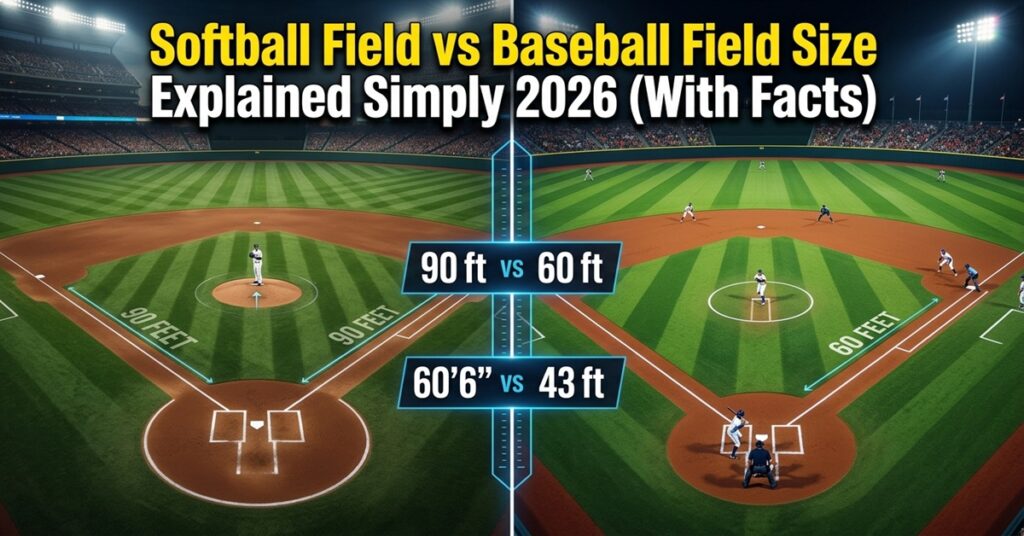

The difference in softball field vs baseball field size is one of the most important factors that shapes how each game is played, yet it is often misunderstood. At first glance, both sports appear to use the same diamond-shaped layout, but the actual measurements tell a very different story.
From base path length to pitching distance and outfield dimensions, every part of the field is designed to match the speed, skill level, and strategy of the game. Understanding the softball field vs baseball field size helps players, coaches, and fans see why baseball emphasizes long-distance power and patience, while softball focuses on speed, reaction time, and fast decision-making.
Most people assume softball and baseball are basically the same game played on slightly different fields. Same diamond. Same bases. Same rules right?
Not even close.
Once you break down softball field vs baseball field size, you realize these two sports are built on completely different physical realities. The distance between bases, pitching speed, field compression, and even reaction time all shift the entire identity of the game.
And here’s the part that surprises most fans:
A few feet in measurement can completely change how a sport feels.
Let’s break it down in a way that actually makes sense.
Softball Field vs Baseball Field Size – Fact Comparison Table (2026)
| Feature / Measurement | Baseball Field ⚾ | Softball Field 🥎 | Key Insight |
|---|---|---|---|
| Base Path Distance | 90 feet | 60 feet | Baseball infield is 30 ft longer per base path |
| Pitching Distance | 60 ft 6 in | 43 ft (fastpitch) / 50 ft (slowpitch) | Softball reduces distance for faster reaction gameplay |
| Pitching Style | Overhand from mound | Underhand from flat circle | Major difference in mechanics & speed perception |
| Pitching Mound | 10-inch elevation | No mound | Softball prioritizes flat-field balance |
| Mound/Circle Diameter | 18 ft mound | 16 ft pitching circle | Softball uses smaller controlled pitching zone |
| Infield Area | ~8,100 sq ft | ~3,600 sq ft | Baseball infield is more than 2× larger |
| Outfield Distance (Youth) | ~200 ft | ~200–220 ft | Similar at youth level for development balance |
| Outfield Distance (Pro/Elite) | 325–400+ ft | 220–300 ft | Baseball requires deeper fields for higher hitting power |
| Home Plate Size | 17-inch width (standard) | Same | Identical geometry in both sports |
| Base Measurement Method | Rear point of home plate | Same | Both use identical diamond geometry rules |
| Backstop Distance | 25–60+ ft | 25–40 ft (typical) | Baseball requires more foul-ball safety space |
| Game Speed | Moderate / strategic | Fast-paced / reaction-based | Softball has quicker defensive transitions |
| Reaction Time | Longer window | Shorter window | Softball increases pressure despite slower pitch speed |
| Field Size Type | Expanded diamond | Compact diamond | Core structural difference |
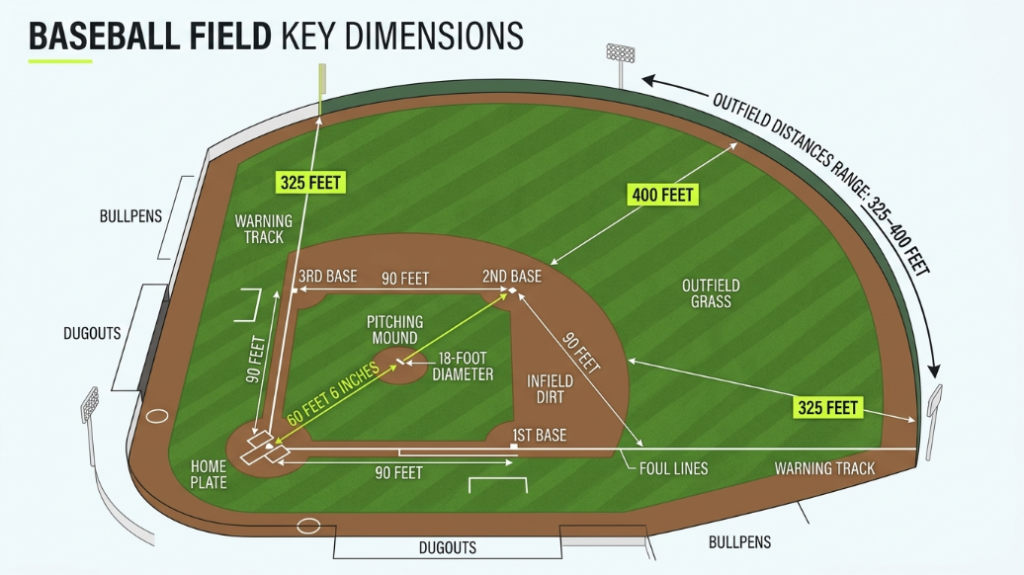
The Baseball Field: Built for Distance, Power, and Time
A baseball field is designed around one core idea: space creates strategy.
At the professional level (MLB), the field follows strict measurements:
- Base paths: 90 feet
- Pitching distance: 60 feet 6 inches
- Pitcher’s mound height: 10 inches
- Outfield fence: typically 325–400+ feet
That extra space isn’t just for looks. It changes everything:
- Batters get more time to react
- Fielders have longer throws
- Strategy becomes more layered and slower-paced
Even the pitching mound matters. That 10-inch elevation gives pitchers mechanical advantage and changes ball trajectory.
And yes, this exact system has been in place since the late 1800s, making baseball one of the most measurement-stable sports in the world.
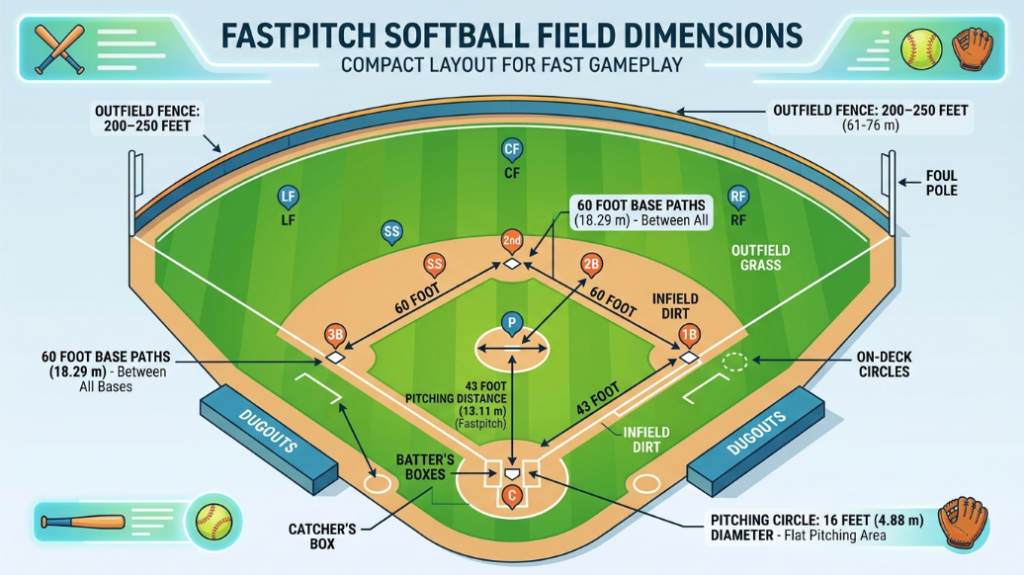
The Softball Field: Smaller, Faster, and Surprisingly Intense
Softball looks simpler at first glance but the field is intentionally compressed to increase speed and intensity.
Standard fastpitch softball dimensions:
- Base paths: 60 feet
- Pitching distance: 43 feet
- Pitching circle: 16 feet (flat surface)
- Outfield fence: 200–250+ feet
No mound. No extra elevation. Just flat ground and explosive pacing.
This creates a completely different rhythm:
- Less reaction time for batters
- Faster defensive plays
- More pressure on infielders
Even though softball pitches are underhand, the shorter distance makes them feel incredibly fast.
Softball Field vs Baseball Field Size (Side-by-Side Reality Check)
Here’s where the difference becomes impossible to ignore:
| Feature | Baseball | Softball |
|---|---|---|
| Base Path | 90 ft | 60 ft |
| Pitching Distance | 60’6” | 43–50 ft |
| Infield Area | ~8,100 sq ft | ~3,600 sq ft |
| Outfield Range | 325–400+ ft | 200–275 ft |
The biggest shock?
The baseball infield is more than twice the size of a softball infield.
That single fact changes:
- reaction time
- throwing distance
- defensive positioning
- scoring frequency
Why Softball Fields Are Smaller (The Real Reason Nobody Talks About)
This isn’t random design. It’s physics + human performance.
1. Pitching style changes everything
- Baseball = overhand + mound advantage
- Softball = underhand + flat release
Softball pitches travel slower in speed but not in perceived difficulty. The shorter distance makes them feel faster than they actually are.
2. Reaction time is the hidden factor
In softball, infielders often have less than a second to react to a ground ball.
That’s why:
- players stand closer
- throws happen faster
- mistakes are more costly
3. Field size balances scoring
Without smaller dimensions, softball would become extremely low-scoring due to reduced pitching distance advantages.
The compact field keeps the game:
- competitive
- fast-paced
- offensively balanced
The Hidden Truth: Softball Is Faster Than Baseball in Many Ways
This surprises a lot of fans.
Even though baseball is known for elite pitching speed, softball often feels faster because:
- distance is shorter
- plays develop quicker
- defensive time windows are smaller
So while baseball is about power + patience, softball is about speed + reaction dominance.
Outfield Differences That Change Home Runs Completely
Outfield size also plays a massive role in scoring.
Baseball outfields:
- Youth: ~200 ft minimum
- High school: 300–325 ft
- MLB: up to 400+ ft
Softball outfields:
- Fastpitch: 200–220 ft
- College: ~220–250 ft
- Slowpitch: 275–300 ft
This is why:
- softball sees more frequent home runs per field size
- baseball home runs feel more “earned” due to longer distance
The Age Progression That Most People Don’t Realize
Both sports scale fields based on development but in very different ways.
Baseball progression:
- T-Ball → 50 ft bases
- Youth → 60–70 ft
- High school → 90 ft
Softball progression:
- 10U → 35 ft pitching
- 12U → ~40 ft
- 14U → 43 ft (full standard)
This gradual scaling isn’t just training it protects:
- arm health
- reaction development
- long-term athlete growth
The Most Underrated Difference: Pitching Distance
If there is ONE number that defines the entire debate, it’s this:
- Baseball: 60 feet 6 inches
- Softball: 43 feet
That 17+ foot difference completely transforms:
- pitch timing
- swing decisions
- strike zone perception
And interestingly, baseball’s odd 60’6” measurement reportedly came from a historical rule adjustment in 1893 that permanently reshaped the sport.
Why These Differences Actually Matter More Than You Think
This isn’t just sports trivia. Field dimensions directly influence:
- how athletes train
- how coaches build strategy
- how players develop skills
- how injuries are prevented
Even small changes in distance create massive changes in performance.
That’s why governing bodies like MLB and softball federations treat field measurements as strict rules not suggestions.
FAQs
Is a softball field bigger than a baseball field?
No, a softball field is smaller than a baseball field. Baseball uses longer base paths and deeper outfield dimensions.
How fast was Jennie Finch’s fastball?
Jennie Finch’s fastball was typically around 68–71 mph. She was known for elite fastpitch speed and control.
Do baseball and softball use the same field?
No, they use a similar diamond layout but different measurements. Softball fields are more compact in size.
Are softball and baseball the same size?
No, baseball fields are significantly larger. The main differences are base path length and pitching distance.
Is it harder to field in softball or baseball?
Softball is harder in terms of reaction time due to shorter distances. Baseball requires more range and longer throws.
Which sports field is bigger?
Baseball fields are bigger than softball fields. They feature longer base paths and deeper outfield fences.
Conclusion
The comparison of softball field vs baseball field size clearly shows that these two sports may share the same structure, but they are built for completely different styles of play. Baseball fields are larger, with longer base paths, deeper outfields, and extended pitching distances that support power hitting and strategic pacing.
In contrast, softball fields are more compact, creating a faster and more intense game where quick reactions and split-second decisions matter most. Ultimately, the softball field vs baseball field size is not just a measurement difference it defines the identity, rhythm, and competitive nature of each sport.