

If you’re planning to build a basketball court, renovate a sports facility, or simply curious about court dimensions, one of the first questions you’ll ask is: How many square feet is a basketball court?
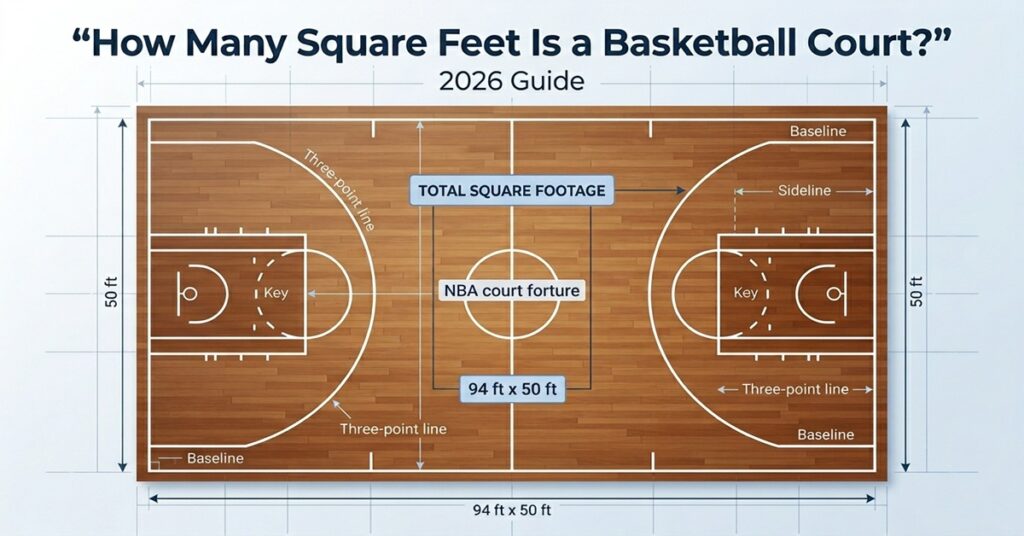
The answer depends on the level of play. A standard NBA or NCAA basketball court measures 94 feet long by 50 feet wide, giving it a total playing area of 4,700 square feet. However, high school, junior high, international, and backyard courts all have different dimensions and square footage requirements.
Understanding basketball court square footage is important for more than just satisfying curiosity. It affects construction costs, material requirements, player safety, training effectiveness, and overall court design. Whether you’re building a backyard basketball court or planning a professional sports facility, knowing the exact measurements can save time, money, and costly mistakes.
In this guide, you’ll learn the square footage of every major basketball court type, how court area is calculated, how much additional space you actually need, and the key dimensions that impact gameplay.
Basketball Court Square Footage – Fact Table
| Court Type | Length (ft) | Width (ft) | Playing Area (sq ft) | With Safety Clearance (Approx.) | Notes |
|---|---|---|---|---|---|
| NBA | 94 | 50 | 4,700 | ~6,240–7,000+ | Professional standard (USA) |
| NCAA | 94 | 50 | 4,700 | ~6,240–7,000+ | Same size as NBA |
| High School | 84 | 50 | 4,200 | ~5,700–6,500 | Slightly shorter court |
| Junior High | 74 | 42 | 3,108 | ~4,200–5,000 | Youth development court |
| Half Court | 47 | 50 | 2,350 | ~3,420–4,000 | Training & casual play |
| FIBA | 91.9 | 49.2 | 4,520 | ~6,000–6,800 | International standard |
What Is the Square Footage of a Basketball Court?
Basketball court area is calculated using a simple formula:
Length × Width = Square Footage
For example:
- Court Length = 94 feet
- Court Width = 50 feet
Calculation:
94 × 50 = 4,700 square feet
This figure represents only the official playing area. In reality, most courts require additional clearance around the perimeter for player safety and facility operations.
Why Basketball Court Square Footage Matters
The total area of a basketball court influences several important factors:
- Construction budgets
- Surface material costs
- Court resurfacing projects
- Lighting requirements
- Drainage planning for outdoor courts
- Safety clearance zones
- Seating and spectator areas
- Sports facility design
For homeowners, square footage determines whether a court can fit in a backyard. For schools and recreation centers, it affects overall facility planning and long-term maintenance costs.
“Court dimensions are standardized to create consistency in player development, competition, and game strategy across different levels of basketball.”
Basketball Court Square Footage by Level of Play
Different organizations use different court sizes. Here’s a quick comparison of the most common basketball court dimensions.
Basketball Court Dimensions Comparison
| Court Type | Length | Width | Square Feet |
|---|---|---|---|
| NBA | 94 ft | 50 ft | 4,700 sq ft |
| NCAA | 94 ft | 50 ft | 4,700 sq ft |
| High School | 84 ft | 50 ft | 4,200 sq ft |
| Junior High | 74 ft | 42 ft | 3,108 sq ft |
| Half Court | 47 ft | 50 ft | 2,350 sq ft |
| FIBA | 91.9 ft | 49.2 ft | 4,520 sq ft |
As you can see, professional and college basketball courts are the largest, while youth courts are scaled down to match player development needs.
NBA Basketball Court Square Footage
The NBA uses the largest standard basketball court in North America.
Official NBA Court Dimensions
- Length: 94 feet
- Width: 50 feet
- Total Area: 4,700 square feet
Professional courts are designed to maximize spacing, athletic performance, and game flow.
Why NBA Courts Are So Large
The NBA features some of the world’s fastest and most athletic players. Larger courts create:
- Better offensive spacing
- More room for transition play
- Increased defensive challenges
- Greater strategic flexibility
The court includes:
- 23 feet 9 inches three-point line
- 15-foot free throw distance
- 16-foot key (paint)
- 10-foot rim height
These dimensions have remained remarkably consistent for decades.
Additional Space Around NBA Courts
The actual footprint of an NBA court is larger than 4,700 square feet.
Most professional arenas include:
- Team benches
- Media zones
- Scorer’s table
- Safety run-off areas
- Camera positions
As a result, the total basketball area inside an arena often exceeds 7,000 square feet.
NCAA College Basketball Court Square Footage
College basketball courts use the same dimensions as NBA courts.
NCAA Court Measurements
| Measurement | Size |
|---|---|
| Length | 94 feet |
| Width | 50 feet |
| Area | 4,700 square feet |
This consistency helps athletes transition from college to professional basketball.
NCAA vs NBA Court Differences
Although the overall court size is identical, some markings differ.
For example:
- NCAA three-point line: 22 feet 1.75 inches
- NBA three-point line: 23 feet 9 inches
This difference influences offensive strategy and shot selection.
College players generally attempt more perimeter shots because the arc is closer to the basket.
High School Basketball Court Square Footage
These courts are slightly smaller than professional courts.
Court Dimensions
- Length: 84 feet
- Width: 50 feet
- Area: 4,200 square feet
This makes the court:
- 10 feet shorter than NBA courts
- 500 square feet smaller overall
Why High School Courts Are Smaller
The reduced length serves several purposes:
- Fits within school gymnasiums
- Matches athlete development levels
- Reduces construction costs
- Maintains competitive spacing
Most schools follow standards established by the National Federation of State High School Associations (NFHS).
Key Features
High school courts still maintain many regulation standards:
- 10-foot rim height
- 15-foot free throw distance
- 19 feet 9 inches three-point line
- 2-inch court markings
These consistent measurements help players develop skills that transfer to higher levels.
Junior High Basketball Court Square Footage
These courts are designed specifically for younger athletes.
Court Dimensions
- Length: 74 feet
- Width: 42 feet
- Area: 3,108 square feet
Compared with NBA courts, junior high courts are:
- 20 feet shorter
- 8 feet narrower
- Nearly 1,600 square feet smaller
Benefits of Smaller Youth Courts
Youth basketball emphasizes skill development over physical size.
Smaller courts help players:
- Improve ball handling
- Learn spacing concepts
- Increase game involvement
- Build confidence
For developing athletes, scaled-down courts often create a more enjoyable learning environment.
FIBA Basketball Court Square Footage
FIBA governs international basketball competitions around the world.
Official FIBA Court Dimensions
- Length: 28 meters (91.9 feet)
- Width: 15 meters (49.2 feet)
- Area: Approximately 4,520 square feet
Although slightly smaller than NBA courts, FIBA courts maintain a similar playing experience.
FIBA vs NBA Court Comparison
| Feature | NBA | FIBA |
|---|---|---|
| Length | 94 ft | 91.9 ft |
| Width | 50 ft | 49.2 ft |
| Area | 4,700 sq ft | 4,520 sq ft |
The difference may seem small, but even a few feet can significantly impact player spacing and defensive strategies.
How Much Space Do You Actually Need for a Basketball Court?
One of the biggest mistakes homeowners make is assuming the court dimensions alone determine the required space.
In reality, the court itself is only part of the equation.
Why Safety Clearance Matters
Players regularly:
- Sprint at full speed
- Dive for loose balls
- Run out of bounds
- Contest shots near sidelines
Without adequate clearance, injuries become much more likely.
Recommended Clearance Space
Most experts recommend:
- Minimum 5 feet around all sides
- 8–10 feet preferred for competitive play
Full Court With Safety Margins
Court dimensions:
- 94 feet × 50 feet
Adding 5 feet around all sides results in:
- 104 feet × 60 feet
Total footprint:
6,240 square feet
That’s over 1,500 square feet larger than the official playing area.
Half Court With Safety Margins
Court dimensions:
- 47 feet × 50 feet
With safety zones:
- 57 feet × 60 feet
Total footprint:
3,420 square feet
Understanding this distinction helps avoid costly design mistakes during construction.
FAQs
Is 30×30 big enough for a basketball court?
No, 30×30 ft is too small for a proper court. It can only work for mini drills or kids’ practice.
What is the size of a high school basketball court?
A standard high school court is 84 ft × 50 ft, totaling 4,200 sq ft of playing area.
How many sq ft is an NBA court?
An NBA court measures 94 ft × 50 ft, which equals 4,700 square feet.
Is a basketball hoop 12 feet high?
No, official basketball rim height is 10 feet (3.05 meters) from the ground.
How far is the NBA 3-point line?
The NBA three-point line is 23 ft 9 in from the basket at the top of the arc.
Can you DIY a basketball court?
Yes, you can build a DIY half or full court using concrete or asphalt with proper markings and hoop setup.
What is the height of a basketball hoop?
The standard basketball hoop height is 10 feet, used in NBA, NCAA, and most leagues worldwide.
Conclusion
How Many Square Feet is a Basketball Court? A basketball court is not a one-size-fits-all space the total square footage varies depending on the level of play. A standard professional or college court measures 4,700 square feet, while high school, youth, and international courts range from roughly 3,100 to 4,520 square feet.
However, the real planning factor is not just the playing surface it’s the total usable space. Once safety margins, run-off zones, seating, and equipment areas are included, a full court can easily require 6,000–7,000+ square feet.
If you’re planning construction or renovation, always design beyond the court lines. Proper spacing improves safety, enhances gameplay experience, and ensures your court meets long-term usability standards.