
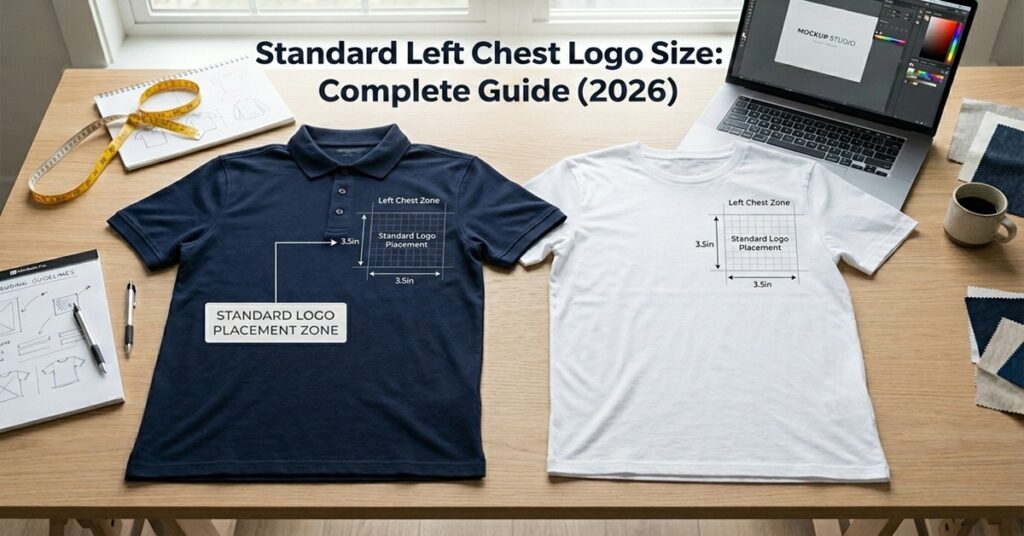

A well-placed logo can instantly make custom apparel look professional, polished, and memorable. Whether you’re creating company uniforms, promotional merchandise, sportswear, school apparel, or branded retail clothing, choosing the correct standard left chest logo size is one of the most important design decisions you’ll make.
Many businesses spend significant time perfecting their logo design but overlook sizing and placement. Even a beautifully designed logo can appear awkward if it’s too large, too small, too high, or too low on the garment.
The good news is that industry professionals have established reliable standards that work across most apparel types. For the majority of garments, the standard left chest logo size falls between 3 and 4 inches wide, with 3.5 inches considered the ideal size for many applications.
In this guide, you’ll learn:
- Standard left chest logo dimensions
- Proper logo placement measurements
- Sizing recommendations by garment type
- Embroidery vs print sizing differences
- Common logo placement mistakes
- Professional tips for achieving consistent results
By the end, you’ll have a clear framework for selecting the right logo size and placement for virtually any garment.
Standard Left Chest Logo Size Chart
| Garment Type | Recommended Width |
|---|---|
| T-Shirts | 3–3.5 inches |
| Polo Shirts | 3.5–4 inches |
| Dress Shirts | 3.5–4 inches |
| Hoodies | 4–4.5 inches |
| Jackets | 4–4.5 inches |
| Women’s Apparel | 3–3.5 inches |
| Sweaters | 3.75–4 inches |
What Is the Standard Left Chest Logo Size?
The standard left chest logo size for adult apparel typically ranges from 3 to 4 inches wide.
Most professional apparel decorators, embroidery shops, and printing companies recommend a width of approximately 3.5 inches because it offers the best balance between visibility and aesthetics.
These measurements work well because they provide enough visibility without overwhelming the garment.
A logo larger than 4.5 inches on the left chest often begins to resemble a front-center design rather than subtle professional branding. Conversely, logos smaller than 2.5 inches can become difficult to recognize from a normal viewing distance.
Why 3.5 Inches Is Often Considered the Sweet Spot
A 3.5-inch logo works exceptionally well because it:
- Remains visible from several feet away
- Fits comfortably on most adult garments
- Maintains proportional balance
- Supports both embroidery and printing methods
- Works across multiple body types
For businesses ordering uniforms in multiple sizes, a 3.5-inch width is often the safest and most versatile choice.
Why Left Chest Logo Size Matters
Many people assume logo placement is purely aesthetic. In reality, sizing affects visibility, readability, production quality, and even how customers perceive your brand.
First Impressions Influence Brand Perception
Research in consumer psychology consistently shows that people form impressions within seconds.
When a logo is properly sized and positioned:
- The garment looks professionally produced
- The brand appears more trustworthy
- Employees present a cohesive image
- Customers perceive greater quality
An oversized logo can make apparel look promotional or inexpensive, while an undersized logo may appear unintentional or insignificant.
Visibility and Recognition
Brand recognition depends on visibility.
A logo that cannot be easily identified from a normal conversation distance loses much of its value.
The ideal left chest logo should:
- Be recognizable from several feet away
- Maintain readability
- Preserve design details
- Support consistent branding
Finding this balance is why industry-standard measurements exist.
Professional Appearance
Corporate uniforms, hospitality apparel, healthcare garments, retail staff shirts, and educational apparel often use left chest logo placement because it communicates professionalism without dominating the garment.
Compared to large front graphics, left chest branding feels more refined and business-oriented.
Standard Left Chest Logo Placement Measurements
Correct placement is just as important as correct sizing.
Even the perfect logo dimensions can look awkward if positioned incorrectly.
Industry Standard Placement
Most professional decorators follow these measurements:
- 7–9 inches down from the shoulder seam
- 4–6 inches inward from center chest
These measurements provide consistent visual balance across most adult garments.
How to Measure Correctly
Follow these steps:
- Lay the garment flat.
- Locate the shoulder seam.
- Measure downward according to garment size.
- Measure inward toward the chest center.
- Mark the logo center point.
- Align the design before production.
Using a template helps ensure consistency across multiple garments.
Placement by Garment Size
| Garment Size | Recommended Drop |
|---|---|
| Small | 6.5–7 inches |
| Medium | 7 inches |
| Large | 7.5 inches |
| XL | 8 inches |
| 2XL–3XL | 8.5 inches |
| 4XL–5XL | 9 inches |
Scaling placement proportionally prevents logos from appearing too high on larger garments.
Left Chest Logo Size by Garment Type
Different garments require different sizing considerations.
Fabric weight, garment construction, and visual proportions all influence the ideal logo dimensions.
T-Shirts
T-shirts typically work best with logos between 3 and 3.5 inches wide.
Because t-shirts feature soft necklines and casual styling, smaller branding generally looks more balanced.
Best uses include:
- Promotional apparel
- Event shirts
- Retail merchandise
- Casual company uniforms
Polo Shirts
Polo shirts are among the most common garments for left chest logos.
The structured collar naturally frames the logo area, allowing slightly larger designs.
Recommended size:
- 3.5–4 inches wide
This range provides excellent visibility while maintaining a polished corporate appearance.
Dress Shirts
Dress shirts often rely on embroidery for branding.
Professional environments typically favor understated branding, making 3.5-inch logos an excellent choice.
Ideal applications include:
- Corporate uniforms
- Executive apparel
- Hospitality staff uniforms
- Trade show clothing
Hoodies
Hoodies provide more visual space and use thicker materials.
As a result, larger logos often look better.
Recommended width:
- 4–4.5 inches
The additional size helps maintain visibility against heavier fabrics.
Jackets
Jackets typically accommodate larger branding than lightweight garments.
Recommended size:
- 4–4.5 inches wide
Outerwear often serves as highly visible branding, especially during outdoor events and corporate activities.
Sweaters and Knitwear
Sweaters introduce texture that can affect logo visibility.
For this reason, slightly larger logos often perform better.
Recommended size:
- 3.75–4 inches wide
The increased size helps logos remain visible against textured fabrics.
Logo Shape and Aspect Ratio Guidelines
Not all logos are shaped the same.
A square logo behaves differently from a horizontal logo, and both require unique sizing considerations.
Square Logos
Square logos are generally the easiest to position.
Examples include:
- Badge-style logos
- Monograms
- Circular emblems
- Icon-based branding
Because width and height are similar, placement remains straightforward.
Horizontal Logos
Many company logos use a horizontal format.
Examples often include:
- Company name beside an icon
- Wordmark logos
- Combination marks
A common example is a 2:1 ratio logo.
A 4-inch-wide logo with a 2:1 ratio produces a 2-inch height.
Because horizontal logos visually extend across the garment, slight upward adjustments often improve balance.
Vertical Logos
Vertical logos require careful sizing because height increases rapidly.
In many cases, reducing width slightly helps maintain proper proportions.
Always Maintain Aspect Ratio
One of the most common branding mistakes is stretching or compressing logos.
Never distort a logo to fit a measurement.
Maintaining the original aspect ratio:
- Protects brand identity
- Preserves professionalism
- Prevents design distortion
- Ensures consistency across products
A distorted logo can undermine years of brand-building efforts.
Left Chest Embroidery Size vs Print Size
Embroidery and printing create very different visual effects.
As a result, the same logo size may not appear identical across decoration methods.
Why Embroidery Looks Larger
Embroidery creates physical dimension through thread.
Raised stitching catches light and creates visual weight.
Because of this effect, embroidered logos often appear larger than printed designs with identical measurements.
Many professional decorators reduce embroidery sizes by approximately 10–15% compared to printed equivalents.
For example:
- 4-inch printed logo
- 3.5-inch embroidered version
Both may appear visually similar.
Embroidery Best Practices
For most left chest embroidery:
- 3–3.75 inches works best
- Avoid excessive detail
- Maintain readable text
- Simplify thin elements when necessary
Small text and intricate artwork may not stitch clearly at reduced sizes.
Printing Advantages
Printing methods generally preserve finer details.
Popular options include:
- Screen printing
- Direct-to-garment (DTG)
- Heat transfer vinyl (HTV)
Because printing produces a flatter finish, logos can often be scaled smaller without losing clarity.
FAQs
What size logo is best for left chest?
A standard left chest logo size is 3 to 4 inches wide, with 3.5 inches being the most commonly used for balance and visibility.
What is a standard logo size?
The standard logo size depends on placement, but for apparel branding, 3–4 inches (left chest) and 10–12 inches (full front) are widely used.
How do you place a left chest logo?
Place it about 7–9 inches down from the shoulder seam and slightly inward from the center chest for proper alignment.
Is a 40-inch chest large or XL?
A 40-inch chest is generally considered a Medium to Large size, depending on brand sizing charts.
Is a 42-inch chest large?
Yes, a 42-inch chest is usually a Large or sometimes XL, depending on the clothing manufacturer’s fit standards.
Conclusion
The standard left chest logo size plays a crucial role in creating professional and visually balanced apparel. In most cases, a width of 3 to 4 inches, with 3.5 inches as the ideal standard, delivers the best results across t-shirts, polo shirts, jackets, and uniforms. However, achieving a polished look is not only about size it also depends on accurate placement and proper scaling for different garment types.
Correct positioning, typically 7 to 9 inches from the shoulder seam, ensures the logo sits naturally on the chest without appearing too high or too low. Adjustments based on garment size, fabric type, and decoration method help maintain consistency and visual harmony. Embroidery may require slightly smaller dimensions, while print methods allow more flexibility in detail.
Ultimately, consistency is key. When sizing, placement, and method are carefully aligned, your branding looks clean, professional, and trustworthy across all apparel.