
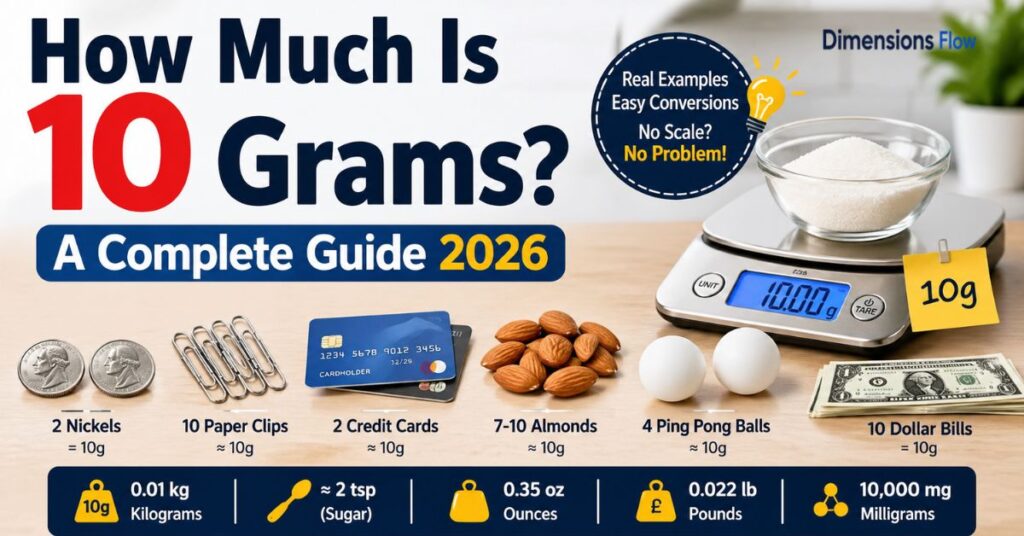

Understanding how much is 10 grams may sound simple, but it is actually one of the most practical measurement skills in daily life. From cooking in the kitchen to handling coins in your pocket or estimating shipping weight, this small unit of mass appears more often than you realize.
In this guide, we break down 10 grams (10g) using real-world objects, scientific conversions, and practical estimation techniques so you can visualize it instantly without needing a scale.
What Is 10 Grams?
In the metric system, a gram (g) is a basic unit of mass used worldwide for measuring small weights.
So:
- 10 grams = 0.01 kilograms
- 10 grams = 10,000 milligrams
- 10 grams ≈ 0.35 ounces
- 10 grams ≈ 0.022 pounds
To put it simply, 10 grams is very light but still physically noticeable in your hand.
It is roughly one-third of an ounce, making it useful for small-scale cooking, science, and everyday estimation tasks.
Why Understanding 10 Grams Matters in Daily Life
You may not notice it, but 10 grams is used constantly in real-world situations, such as:
- Cooking and baking measurements
- Mailing letters and parcels
- Portion control in nutrition
- Estimating small objects without a scale
- Science experiments in schools
Even though it is a tiny weight, it helps build a strong foundation for understanding the metric system and weight estimation skills.
10 Grams in Other Units (Quick Conversion Guide)
Here is how 10 grams converts into other commonly used units:
| Unit | Value |
|---|---|
| Kilograms | 0.01 kg |
| Milligrams | 10,000 mg |
| Ounces | 0.35 oz |
| Pounds | 0.022 lb |
| Carats | 50 ct |
| Grains | 154.3 gr |
In kitchen terms:
- Approximately 2 teaspoons of sugar equals 10 grams
- About 2/3 tablespoon depending on ingredient density
These conversions vary depending on material density, so weight is always more accurate than volume.
How Heavy Is 10 Grams (Simple Visualization)
If you are trying to feel 10 grams, think of it like:
- A small handful of paper clips
- A couple of coins in your pocket
- A light pencil in your hand
- A few almonds
In real terms:
- Light enough to barely notice in your palm
- Heavy enough to measure and compare
- Common enough to appear in everyday objects
This makes it a useful reference weight for estimation without tools.
Everyday Objects That Weigh 10 Grams
One of the easiest ways to understand how much is 10 grams is by comparing it with familiar objects.
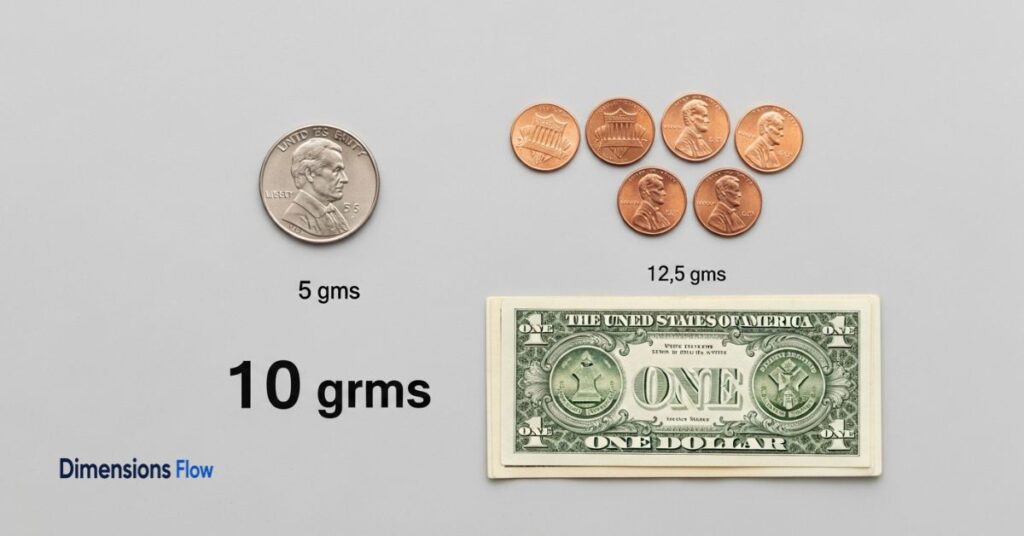
Coins and Money-Based References
- 2 US nickels equal 10 grams exactly
- 4 US pennies equal 10 grams exactly
- 10 US dollar bills equal 10 grams
Why this works:
Coins and bills are manufactured with strict standards, making them reliable for weight comparison.
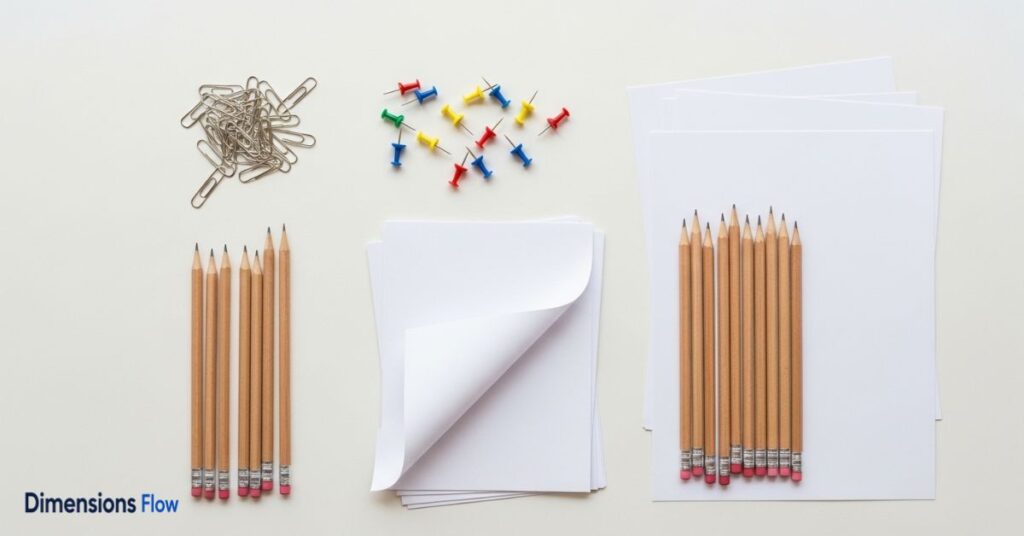
Office and Stationery Items
- 10 paper clips approximately 10 grams
- 10 thumbtacks approximately 10 grams
- 2 A4 paper sheets approximately 10 grams
- 1 standard graphite pencil approximately 7 to 10 grams
Insight:
Paper and metal office supplies are consistent, making them useful for estimation without a scale.
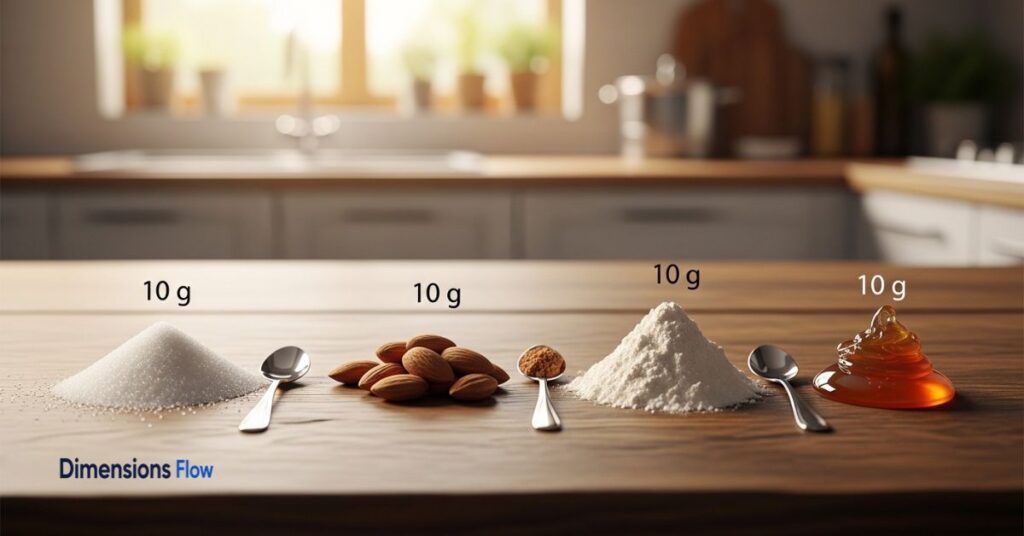
Food Items (Cooking Reference)
- 2 teaspoons of sugar approximately 10 grams
- 7 to 10 almonds approximately 10 grams
- 1 tablespoon flour approximately 8 to 10 grams
Important note:
Food weight varies based on density, humidity, and how it is packed.
For example:
- Sugar is heavier per spoon than flour
- Flour weight changes depending on scooping method
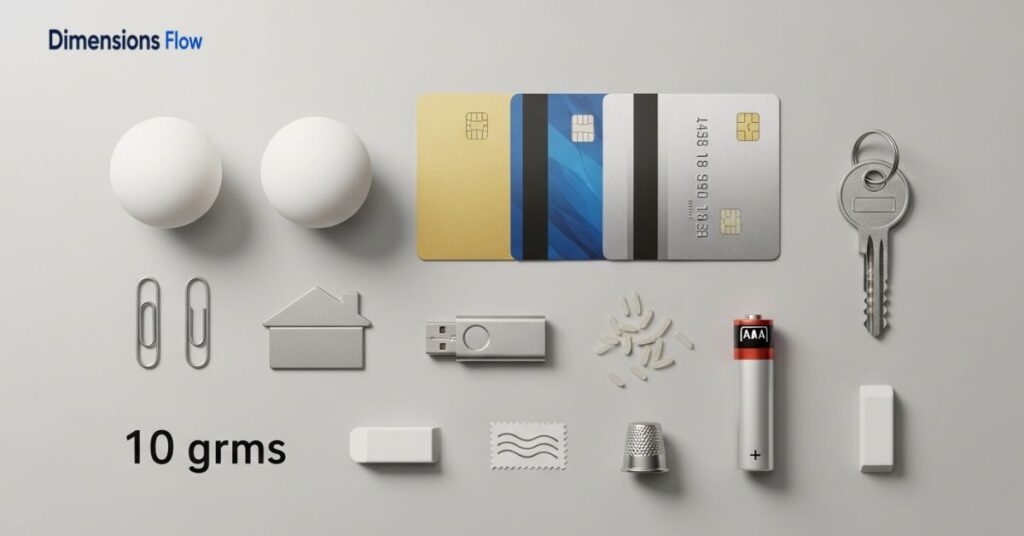
Miscellaneous Everyday Objects
- 4 ping pong balls approximately 10.8 grams
- 2 credit cards approximately 10 grams
These are useful for visual learners who want real-world comparisons.
Why These Objects Work as Weight References
You might wonder why these items are so consistent.
Here is the science behind it:
Standardized manufacturing
Coins, cards, and paper are produced under strict industrial guidelines.
Stable materials
- Metal coins have consistent density
- PVC cards maintain uniform structure
- Paper follows standardized GSM measurement
Predictable mass production
Manufacturing ensures each item stays within a small weight range.
How to Measure 10 Grams Without a Scale
If you do not have a scale, you can still estimate 10 grams quite accurately.
Kitchen Spoon Method
- 2 level teaspoons of sugar approximately 10 grams
- About 2/3 tablespoon approximately 10 grams
Best for:
- Cooking
- Baking
- Home use
Coin Method
- 2 nickels equal 10 grams
- 4 pennies equal 10 grams
This is one of the most accurate non-digital methods.
DIY Balance Method
You can create a simple balance using:
- A ruler
- A pencil as a fulcrum
- A known 10 gram object
When both sides balance, you have approximately 10 grams.
Digital Kitchen Scale (Most Accurate Method)
A digital scale is the most reliable way to measure 10 grams.
Steps:
- Place container on scale
- Press tare to reset to zero
- Add material until display shows 10 grams
Accuracy level:
- Most kitchen scales have ±0.1 gram precision
- Ideal for baking, nutrition, and lab use
10 Grams vs Other Common Weights
Understanding comparisons makes 10 grams easier to grasp:
- 10 grams vs 1 gram equals 10 times heavier
- 10 grams vs 100 grams equals 10 times lighter
- 10 grams vs 1 ounce is about one-third
- 10 grams vs 1 pound is extremely small
Key insight:
10 grams is a micro weight, small in bulk but important in precision tasks.
Frequently Asked Questions
How many teaspoons is 10 grams?
Approximately 2 teaspoons for sugar or water, but it varies by ingredient density.
Is 10 grams equal to 1 tablespoon?
No. 1 tablespoon of water is about 15 grams, so 10 grams is approximately 2/3 tablespoon.
How can I measure 10 grams without a scale?
You can use:
- 2 nickels
- 4 pennies
- 2 teaspoons of sugar
- 10 paper clips
Is 10 grams half an ounce?
No. 10 grams is approximately 0.35 ounces. Half an ounce is about 14 grams.
Can a phone measure 10 grams?
Only with limited accuracy. Phones are not reliable for precise weight measurement.
Real-Life Uses of Knowing 10 Grams
Understanding this small measurement helps in:
- Cooking precision and baking
- Shipping weight estimation
- Science experiments
- Portion control in dieting
- Everyday estimation without tools
Final Thoughts
At first glance, 10 grams may look insignificant, but it is actually a powerful reference point for understanding weight in everyday life.
From coins in your pocket to almonds in your hand, you already interact with 10 grams constantly without realizing it.
Once you learn to recognize it visually, you gain a practical skill that makes cooking, estimating, and measuring much easier without relying on tools every time.