
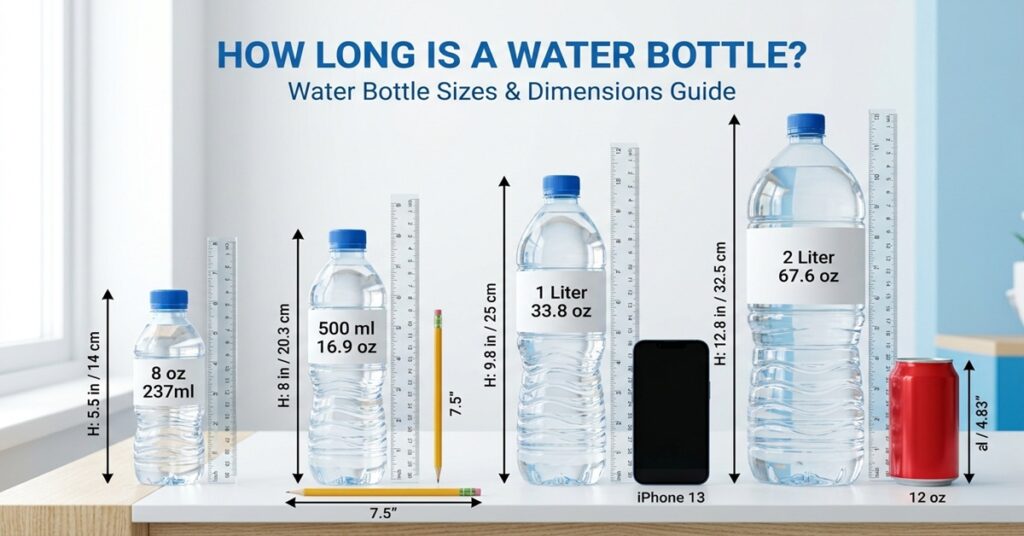

If you’ve ever wondered how long is a water bottle, you’re not alone. Whether you’re buying a new reusable bottle, checking if a bottle will fit in your car’s cup holder, comparing sizes for travel, or planning storage space, understanding water bottle dimensions can be surprisingly useful.
Most people think of a water bottle as a simple everyday item, but bottles come in many shapes and capacities. A small 8-ounce bottle differs significantly from a large 2-liter hydration bottle, and those differences affect portability, convenience, and overall usability.
In general, a standard water bottle is about 8 inches (20.3 cm) long or tall, but the exact measurement depends on the bottle’s capacity, design, and intended use.
This guide explores common water bottle lengths, dimensions by size, how manufacturers measure bottles, and how different bottle designs compare in real-world situations.
How Long Is a Water Bottle? Quick Answer
The length of a water bottle is usually measured from the base to the top rim, which is technically its height. Since water bottles stand upright, many people use the terms length and height interchangeably.
Here are the typical dimensions for common water bottle sizes:
| Bottle Size | Length/Height (Inches) | Length/Height (cm) |
|---|---|---|
| 8 oz (237 ml) | 5.5 in | 14 cm |
| 12 oz (355 ml) | 7 in | 17.8 cm |
| 16.9 oz (500 ml) | 8 in | 20.3 cm |
| 20 oz (591 ml) | 8.9 in | 22.6 cm |
| 32 oz (946 ml) | 10.5 in | 26.7 cm |
| 1 Liter | 11 in | 27.9 cm |
| 1.5 Liter | 12.25 in | 31.1 cm |
| 2 Liter | 12.5 in | 31.8 cm |
For most consumers, the standard 500ml bottle serves as the reference point. It is approximately 8 inches long, making it easy to carry and store.
Understanding Water Bottle Dimensions
Before comparing bottle sizes, it helps to understand the three measurements manufacturers commonly use.
Is Water Bottle Length the Same as Height?
Technically, water bottles have a height rather than a length because they are designed to stand vertically.
However, many shoppers search for:
- How long is a water bottle?
- Water bottle length
- Bottle size dimensions
In everyday language, these phrases usually refer to the bottle’s height from bottom to top.
The Three Key Measurements
Water bottle dimensions include:
- Height (Length) – distance from base to top rim.
- Diameter (Width) – width across the widest part.
- Capacity – amount of liquid the bottle can hold.
Together, these measurements determine whether a bottle fits:
- Cup holders
- Backpack pockets
- Refrigerator shelves
- Bike cages
- Gym bag compartments
Why Dimensions Matter
Choosing the wrong size can create everyday frustrations.
For example:
- A bottle may be too tall for a lunch bag.
- A wide bottle may not fit a vehicle cup holder.
- A large hydration bottle may be too heavy for hiking.
Knowing dimensions beforehand helps avoid these issues.
Common Water Bottle Lengths by Bottle Type
Not all water bottles are designed the same way.
Disposable Plastic Water Bottles
Disposable bottles are among the most standardized products worldwide.
Typical measurements include:
| Capacity | Average Length |
|---|---|
| 8 oz | 5.5 inches |
| 12 oz | 7 inches |
| 16.9 oz | 8 inches |
| 20 oz | 8.9 inches |
The 500ml bottle became popular because it balances portability with sufficient hydration for daily activities.
Reusable Plastic Water Bottles
Reusable plastic bottles often have thicker walls than disposable bottles.
Because of this:
- Diameter may increase slightly.
- Weight increases.
- Durability improves.
Most reusable bottles range from:
- 8 to 11 inches in length
- 2.5 to 3.5 inches in diameter
Stainless Steel Water Bottles
Insulated stainless steel bottles are designed differently.
Manufacturers often make them:
- Taller
- Slimmer
- More durable
This design allows them to fit cup holders while maximizing capacity.
Common lengths include:
| Capacity | Average Length |
|---|---|
| 18 oz | 9 inches |
| 24 oz | 10 inches |
| 32 oz | 11 inches |
Sports and Gym Water Bottles
Sports bottles prioritize quick hydration.
Typical dimensions include:
- Length: 9–11 inches
- Diameter: 2.75–3.5 inches
Many feature:
- Wide-mouth openings
- Easy-pour spouts
- Measurement markings
- Squeeze designs
Large Hydration Bottles
Large bottles focus on minimizing refill frequency.
Common examples include:
| Capacity | Average Length |
|---|---|
| 1 Liter | 11 inches |
| 1.5 Liter | 12.25 inches |
| 2 Liter | 12.5 inches |
These bottles are popular among:
- Athletes
- Hikers
- Outdoor workers
- Fitness enthusiasts
Visualizing How Long a Water Bottle Is
Measurements are useful, but visual comparisons make size easier to understand.
A Standard Water Bottle Is About the Same Length As
A typical 500ml water bottle measures roughly 8 inches.
That’s approximately the same size as:
- A standard wooden pencil
- A tablet screen
- Two credit cards placed end to end
- An adult hand span
Water Bottle vs Common Household Items
| Item | Approximate Length |
|---|---|
| Standard pencil | 7.5 inches |
| 500ml water bottle | 8 inches |
| Large smartphone | 6.5 inches |
| Soda can | 4.8 inches |
| TV remote | 7–8 inches |
These comparisons help shoppers estimate size without a ruler.
Why Visual Comparisons Matter
Research on consumer behavior consistently shows that buyers understand dimensions better when compared to familiar objects.
Instead of imagining 20.3 centimeters, most people instantly recognize the size of a pencil or remote control.
Water Bottle Length Comparison Chart
Bottle size directly affects overall dimensions.
Small vs Standard vs Large Bottles
| Category | Length Range |
|---|---|
| Small (8–12 oz) | 5.5–7 inches |
| Standard (16.9–20 oz) | 8–9 inches |
| Large (32 oz–1 Liter) | 10–11 inches |
| Extra Large (1.5–2 Liters) | 12–12.5 inches |
Best Size for Different Activities
| Activity | Recommended Size |
|---|---|
| School | 12–20 oz |
| Office Work | 16.9–32 oz |
| Gym | 24–32 oz |
| Hiking | 1–2 Liter |
| Road Trips | 20 oz–1 Liter |
Selecting the right size improves convenience and hydration habits.
How Bottle Capacity Affects Length
Many people assume doubling capacity doubles bottle length.
In reality, that rarely happens.
Why Bigger Bottles Aren’t Always Much Taller
Manufacturers increase capacity through:
- Additional height
- Greater diameter
- Modified shapes
For example:
| Bottle | Height |
|---|---|
| 500ml | 8 inches |
| 1 Liter | 11 inches |
Although capacity doubles, height increases by only 3 inches.
Tall and Narrow Bottles vs Short and Wide Bottles
Both designs have advantages.
Tall and Narrow Bottles
Benefits:
- Better cup holder compatibility
- Easier carrying
- Modern appearance
Drawbacks:
- Higher center of gravity
- More likely to tip over
Short and Wide Bottles
Benefits:
- Greater stability
- Easier cleaning
- Better insulation potential
Drawbacks:
- Poor cup holder fit
- Bulkier storage
The Engineering Behind Bottle Design
Bottle designers balance several factors:
- User comfort
- Material costs
- Stability
- Capacity
- Manufacturing efficiency
A small change in diameter can significantly increase volume without dramatically increasing bottle length.
How to Measure the Length of a Water Bottle
Accurate measurements are easy to obtain at home.
Tools You’ll Need
You can use:
- Ruler
- Measuring tape
- Calipers
- Measuring stick
Step-by-Step Measurement Process
- Place the bottle on a flat surface.
- Position a ruler vertically.
- Measure from the base to the top rim.
- Record the result in inches or centimeters.
Should You Include the Cap?
Most manufacturers measure:
- Base to bottle rim
- Cap excluded
However, some retail listings include cap height.
Always verify the measurement method when comparing products.
Measuring Irregular Bottles
For bottles with handles or unique designs:
- Measure the tallest point.
- Measure the widest diameter separately.
- Record both values.
This provides the most accurate sizing information.
Water Bottle Lengths Around the World
Bottle sizes vary by region.
Popular Bottle Sizes Globally
Common capacities include:
| Region | Common Sizes |
|---|---|
| North America | 500ml, 591ml, 1 Liter |
| Europe | 500ml, 750ml, 1.5 Liter |
| Asia | 350ml, 500ml, 1 Liter |
| Australia | 600ml, 750ml, 1 Liter |
Despite regional differences, most bottles remain between 7 and 12 inches long.
Metric vs Imperial Measurements
Consumers often encounter both systems.
Quick conversions:
| Measurement | Equivalent |
|---|---|
| 1 inch | 2.54 cm |
| 8 inches | 20.3 cm |
| 10 inches | 25.4 cm |
| 12 inches | 30.5 cm |
Understanding both systems helps when comparing international products.
Choosing the Right Water Bottle Length for Your Needs
The best bottle size depends on how you plan to use it.
For Car Cup Holders
Most vehicle cup holders accommodate bottles:
- Up to 3 inches in diameter
- Up to 10 inches tall
A 500ml or 20-ounce bottle usually works best.
For Backpacks and School Bags
Ideal bottle length:
- 7–10 inches
These sizes fit most side pockets without protruding excessively.
For Air Travel and Commuting
Travelers often prefer:
- 16.9 oz bottles
- 20 oz bottles
- Slim insulated bottles
These provide a balance between hydration and portability.
For Sports and Outdoor Activities
Outdoor users typically benefit from:
- 32 oz bottles
- 1-liter bottles
- 2-liter hydration options
Larger capacities reduce refill frequency.
Surprising Facts About Water Bottle Sizes
Why Most Bottles Are Around 8 Inches Long
The popularity of the 500ml bottle isn’t accidental.
Manufacturers favor this size because it:
- Fits most cup holders
- Fits vending machines
- Provides convenient hydration
- Minimizes transportation costs
The result is an industry standard used worldwide.
The Evolution of Water Bottle Design
Water bottles have changed dramatically over the last few decades.
Earlier bottles focused on:
- Low manufacturing costs
- Single-use convenience
Modern designs emphasize:
- Reusability
- Insulation
- Sustainability
- Ergonomics
Today’s reusable bottles often incorporate advanced vacuum insulation while maintaining practical dimensions.
How Bottle Dimensions Influence Hydration Habits
Studies on hydration behavior suggest that people often drink more water when larger bottles are readily available.
A larger bottle:
- Requires fewer refills
- Serves as a visual reminder
- Makes tracking intake easier
However, oversized bottles may reduce portability and convenience.
“The best water bottle is not necessarily the biggest one—it’s the one you’ll consistently carry and use.”
This principle explains why medium-sized bottles remain the most popular choice.
Water Bottle Dimensions at a Glance
| Capacity | Height | Diameter |
|---|---|---|
| 8 oz | 5.5 in | 2.25 in |
| 12 oz | 7 in | 2.5 in |
| 16.9 oz | 8 in | 2.5 in |
| 20 oz | 8.9 in | 2.75 in |
| 32 oz | 10.5 in | 3 in |
| 1 Liter | 11 in | 3 in |
| 1.5 Liter | 12.25 in | 3.5 in |
| 2 Liter | 12.5 in | 4 in |
This chart provides a quick reference when comparing bottle sizes.
Frequently Asked Questions
Is a water bottle 8 inches?
Yes, a standard 16.9 oz (500ml) water bottle is typically about 8 inches tall. Smaller and larger bottles vary in size.
How long is a standard water bottle?
A standard water bottle is usually around 8 inches (20.3 cm) long or tall. This refers to the common 500ml size.
How long is a 16.9 water bottle?
A 16.9 oz (500ml) water bottle is approximately 8 inches (20.3 cm) in height with a 2.5-inch diameter.
What is the length of a 500ml water bottle?
Most 500ml water bottles measure about 8 inches (20.3 cm) from the base to the top rim.
How tall is a plastic 500ml water bottle?
A typical plastic 500ml water bottle stands about 8 inches tall. Dimensions may vary slightly by brand.
How tall is one water bottle?
The height of a water bottle depends on its size, but most standard bottles are around 8 inches tall.
Conclusion
Understanding how long a water bottle is helps you choose the right bottle for your lifestyle, storage space, and hydration needs. While dimensions vary by design and capacity, most standard water bottles measure around 8 inches long, making them ideal for everyday use.
Smaller bottles range from about 5.5 to 7 inches, while larger hydration bottles can exceed 12 inches. Beyond length, factors such as diameter, weight, capacity, and intended use play an important role in selecting the right bottle.
Whether you need a compact bottle for commuting, a gym bottle for workouts, or a large hydration bottle for outdoor adventures, knowing the dimensions beforehand ensures a better fit, greater convenience, and a more satisfying hydration experience.