
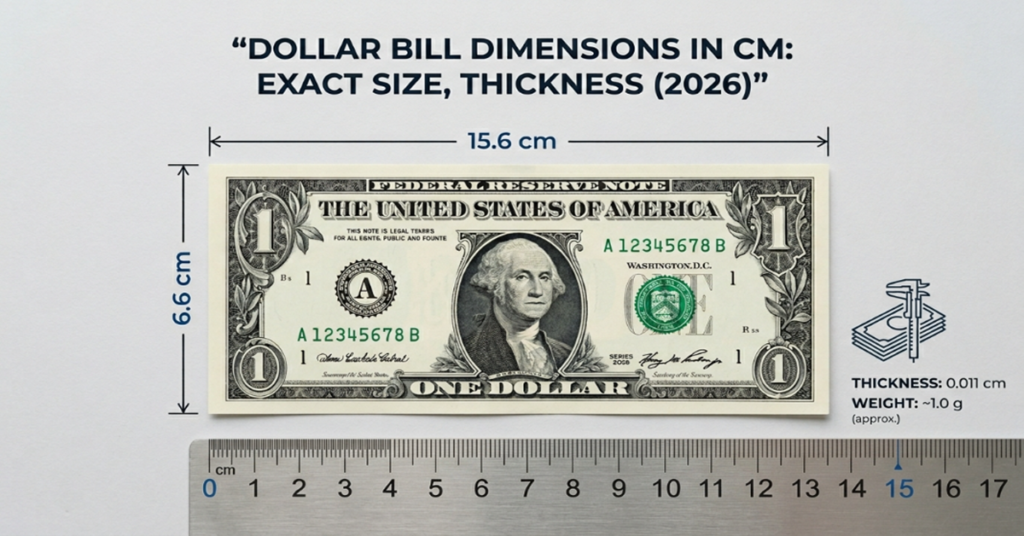

Dollar bill dimensions in cm are more useful than you might think. Whether you’re a student working on a project, a designer building wallet layouts, or simply curious about everyday objects, understanding the exact size of U.S. currency gives you practical insight into something you handle regularly.
In this comprehensive guide, we’ll break down:
- The exact dollar bill size in centimeters (cm) and millimeters (mm)
- Thickness and stack calculations in metric units
- Why all U.S. bills share identical dimensions
- Historical changes in currency size
- Real-world comparisons to help you visualize it better
Let’s dive in.
Exact Dollar Bill Dimensions in CM
The standard U.S. dollar bill has remained unchanged in size for nearly a century. Here are the exact measurements:
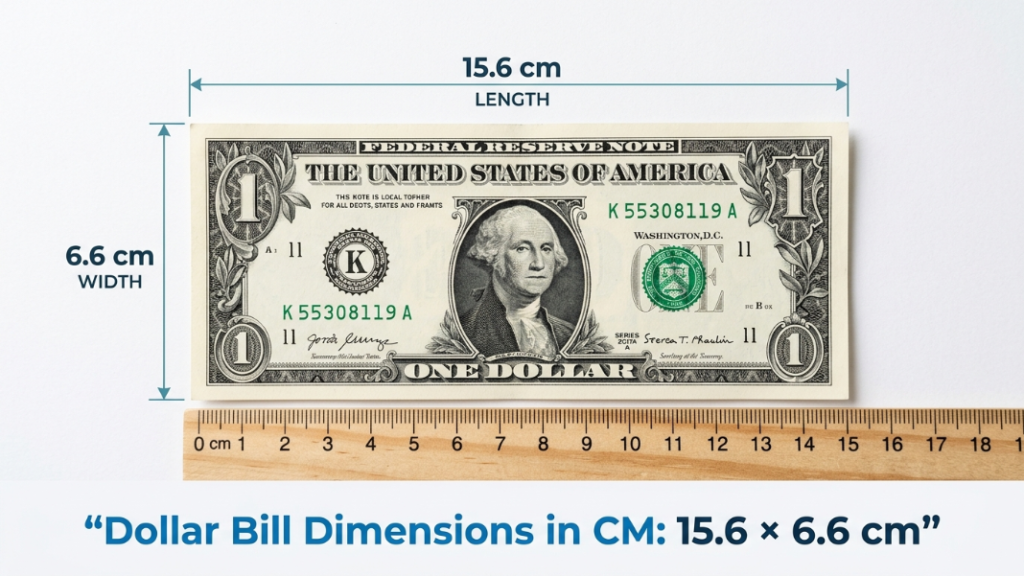
- Length: 15.6 cm
- Width (Height): 6.6 cm
- Thickness: 0.011 cm (approx.)
In millimeters:
- 156 mm × 66.3 mm
These dimensions are consistent across all denominations from $1 to $100. :contentReference[oaicite:0]{index=0}
Why These Numbers Matter
At first glance, these measurements may seem trivial. But they play a key role in:
- Machine processing (ATMs, vending machines)
- Wallet and storage design
- Currency recognition and anti-counterfeiting
Quick Conversion Table (CM, MM, Inches)
| Feature | Centimeters | Millimeters | Inches |
|---|---|---|---|
| Length | 15.6 cm | 156 mm | 6.14 in |
| Width | 6.6 cm | 66.3 mm | 2.61 in |
| Thickness | 0.011 cm | 0.109 mm | 0.0043 in |
Note: Slight variations may occur due to wear and circulation.
Why Dollar Bill Dimensions Are Standardized
Before 1929, U.S. currency came in different sizes. Some notes were significantly larger often referred to as “horse blanket currency.”
That changed in 1929 when the U.S. government standardized all paper money.
Key Reasons for Standardization
- Cost efficiency: Smaller bills reduced printing expenses
- Durability: Compact size improved lifespan
- Machine compatibility: ATMs and vending machines rely on uniform size
- Storage efficiency: Banks could store more cash in less space
Today, every U.S. bill follows the same dimensions: 15.6 × 6.6 cm. :contentReference[oaicite:1]{index=1}
Are All U.S. Bills the Same Size in CM?
Yes, every U.S. dollar bill shares identical dimensions.
Uniform Across All Denominations:
- $1
- $5
- $10
- $20
- $50
- $100
Each one measures 15.6 cm × 6.6 cm, regardless of value. :contentReference[oaicite:2]{index=2}
What Changes Instead?
While the size stays the same, differences include:
- Portraits (e.g., George Washington, Benjamin Franklin)
- Colors and design elements
- Security features (threads, watermarks)
This uniformity is unique compared to many global currencies, where size varies by denomination.
Dollar Bill Thickness in CM (Often Overlooked)
Most guides focus on length and width but thickness is just as important.
- Single bill thickness: 0.011 cm
- Equivalent: 0.109 mm
That’s thinner than a sheet of standard paper.
What Is a Dollar Bill Made Of?
U.S. currency is not paper it’s made from:
- 75% cotton
- 25% linen
This blend gives it:
- High durability
- Resistance to tearing
- Ability to withstand thousands of folds
Stack Height Calculations in CM
Understanding stack height adds a practical dimension to these measurements.
Common Stack Examples
- 10 bills: ~0.11 cm
- 100 bills: ~1.1 cm
- 1,000 bills: ~11 cm
A stack of 1,000 dollar bills reaches about 4.3 inches (10.9 cm). :contentReference[oaicite:3]{index=3}
Real-World Visualization
- 1,000 bills ≈ height of a coffee mug
- 10,000 bills ≈ 110 cm (over 1 meter tall)
- 1 million dollars (in $1 bills) ≈ several meters high
This makes stack calculations useful for:
- Bank storage planning
- Cash handling systems
- Educational demonstrations
Real-Life Size Comparisons (Easy Visualization)
Numbers are helpful but comparisons make them memorable.
A dollar bill (15.6 × 6.6 cm) is:
- Slightly smaller than a smartphone in height
- Close to a playing card (but longer and narrower)
- Roughly half the length of a standard ruler
- Designed to fit perfectly inside a bi-fold wallet
These comparisons help you visualize dimensions without measuring tools.
Historical Dollar Bill Dimensions (Before 1929)
Before standardization, U.S. currency was much larger.
Old Bill Dimensions:
- Approx. 18.7 cm × 7.9 cm
These oversized notes were:
- Harder to store
- More expensive to produce
- Less practical for everyday use
The 1929 redesign reduced size by nearly 30%, making currency more efficient and modern. :contentReference[oaicite:4]{index=4}
Comparison with Other World Currencies
Unlike U.S. currency, many countries use different sizes for different denominations.
Examples:
- Euro: Larger notes = higher value
- British Pound: Gradual size increase by denomination
Why the Difference?
Other countries prioritize:
- Accessibility (especially for visually impaired users)
- Easy identification by touch
The U.S., however, prioritizes:
- Uniformity
- Machine efficiency
- Lower production costs
How Dollar Bill Dimensions Affect Everyday Life
These measurements influence more than you might expect.
Practical Applications
1. Wallet Design
Wallets are built specifically to accommodate 15.6 cm length.
2. ATMs & Machines
Machines rely on fixed dimensions for:
- Accurate counting
- Smooth processing
- Fraud detection
3. Retail Systems
Cash drawers and registers are designed around standard bill size.
4. Education & DIY Projects
Students and designers use dollar bill dimensions as a reference unit.
FAQs
What are the dimensions of a dollar bill in cm?
A U.S. dollar bill measures 15.6 cm × 6.6 cm.
Is a $100 bill larger than a $1 bill?
No. All denominations share the same size.
How thick is a dollar bill in cm?
Approximately 0.011 cm.
Why doesn’t the U.S. use different bill sizes?
Because uniform size improves:
- Efficiency
- Machine compatibility
- Production costs
Interesting Facts About Dollar Bill Size
- The size hasn’t changed since 1929
- A dollar bill weighs about 1 gram :contentReference[oaicite:5]{index=5}
- It can withstand thousands of folds before tearing
- It’s often used as a reference measurement tool
Pro Tips to Remember Dollar Bill Dimensions in CM
Here are simple ways to remember:
The “15 by 6 Rule”
Think:
- Length ≈ 15 cm
- Width ≈ 6 cm
Visual Shortcut
Imagine:
- A slim rectangle slightly larger than your phone width
Everyday Memory Hack
Use a dollar bill as a quick measuring tool for small objects.
Conclusion
Dollar bill dimensions in cm 15.6 × 6.6 cm are more than just numbers. They represent a carefully designed standard that has shaped American currency for nearly a century.
From wallet design to global financial systems, these measurements play a crucial role in efficiency, durability, and usability. While other countries vary their banknote sizes, the United States relies on consistency and that decision continues to support modern banking and everyday transactions.
Understanding these dimensions gives you a new perspective on something you use all the time. It turns a simple piece of currency into a practical tool, a design marvel, and a small but important part of financial history.