
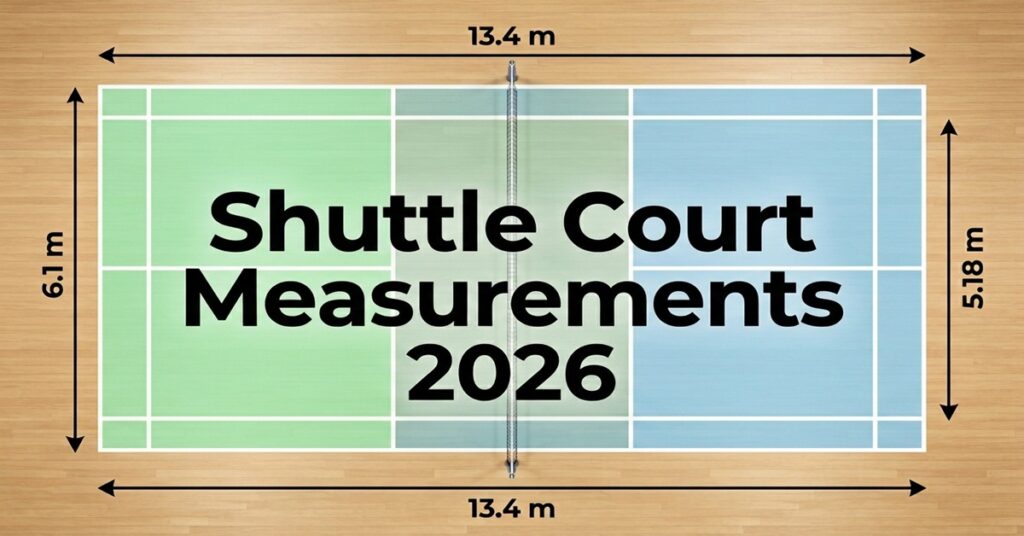

Understanding shuttle court measurements is essential whether you are building a professional badminton facility, setting up a school court, or simply improving a home playing space. Even a small error in court dimensions can affect gameplay, fairness, and player movement.
In badminton, precision is not optional it is the foundation of the sport. The official standards defined by the Badminton World Federation ensure that every rally, serve, and shot happens under consistent global conditions.
In this detailed guide, we break down everything you need to know about shuttle court measurements, including official dimensions, court markings, net height rules, setup instructions, and common mistakes to avoid.
Understanding Shuttle Court Measurements in Badminton
What “Shuttle Court Measurements” Really Mean
The term shuttle court measurements refers to the standardized dimensions used to construct and mark a badminton court. These measurements include:
- Court length and width
- Singles and doubles playing areas
- Service lines and boundary markings
- Net height and post positioning
- Total playing surface area
Unlike many recreational sports, badminton has a highly regulated playing area. The court is not just a rectangle it is divided into carefully measured zones that directly affect scoring rules and player positioning.
Why Accurate Court Dimensions Matter
Correct shuttle court measurements are important for three main reasons:
1. Fair competition
- Ensures equal playing conditions worldwide
- Prevents advantages due to incorrect court sizing
2. Player performance
- Influences movement, footwork, and shot selection
- Incorrect width or length can distort gameplay strategy
3. Safety
- Proper spacing prevents collisions and injuries during fast rallies
Even a few centimeters of error can change how the shuttle behaves on court.
Official Shuttle Court Measurements (Standard Dimensions)
Standard Court Size Overview
A regulation badminton court has fixed dimensions regardless of country or level of play:
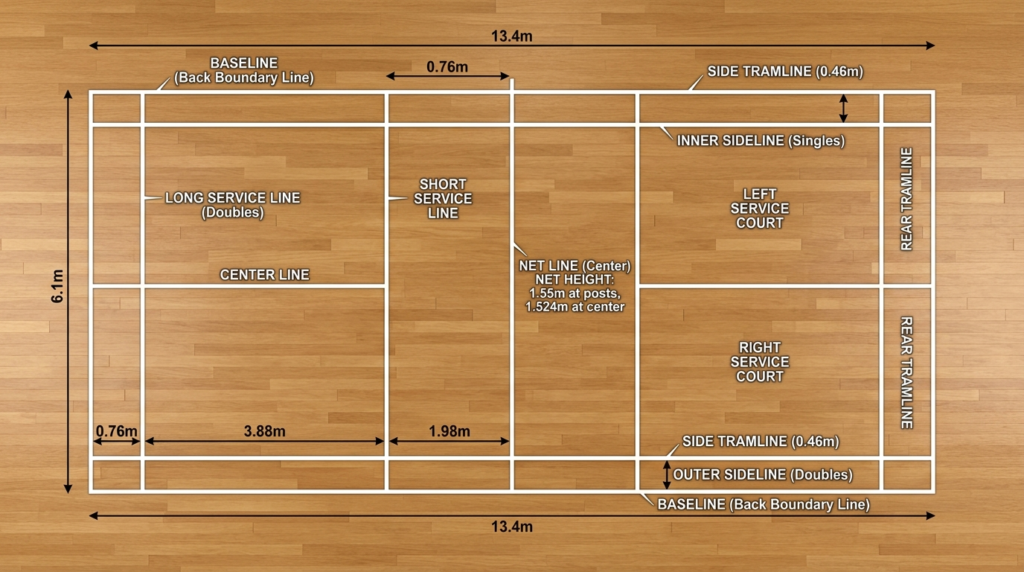
- Court length: 13.4 meters (44 feet)
- Doubles court width: 6.1 meters (20 feet)
- Singles court width: 5.18 meters (17 feet)
The length remains constant for both singles and doubles, while the width changes depending on match format.
Playing Area Comparison Table
| Court Type | Length | Width | Area (approx.) |
|---|---|---|---|
| Singles | 13.4 m | 5.18 m | 69.41 m² |
| Doubles | 13.4 m | 6.1 m | 81.74 m² |
The difference in width significantly changes game dynamics. Doubles matches require more lateral coverage, while singles emphasize endurance and full-court movement.
Why Length Remains the Same
One of the most important aspects of shuttle court measurements is that the length never changes.
This ensures:
- Consistency in serve distance
- Uniform rally structure
- Standardized backcourt pressure
A badminton court is designed around fast directional movement, so maintaining a fixed length ensures predictable gameplay patterns.
Court Layout Explained: Lines and Markings
Baselines and Sidelines
The court is enclosed by four main boundary lines:
- Baselines: Located at each end of the court
- Sidelines: Define width boundaries (different for singles and doubles)
Key point:
- Doubles uses the full width
- Singles uses the inner sideline
This is one of the most misunderstood parts of shuttle court measurements.
Service Lines and Center Line
Service areas are divided into precise zones:
Short Service Line
- Located near the net
- Ensures serves must clear the net properly
Long Service Line (Doubles only)
- Marks the back boundary for doubles serves
- Singles uses the full baseline instead
Center Line
- Divides left and right service courts
- Ensures correct serve direction
Why Court Markings Matter
Accurate markings affect:
- Fault detection
- Serve legality
- Shot placement accuracy
In professional badminton, even a minor line error can influence match outcomes.
Net Height and Placement Standards
Official Net Height Measurements
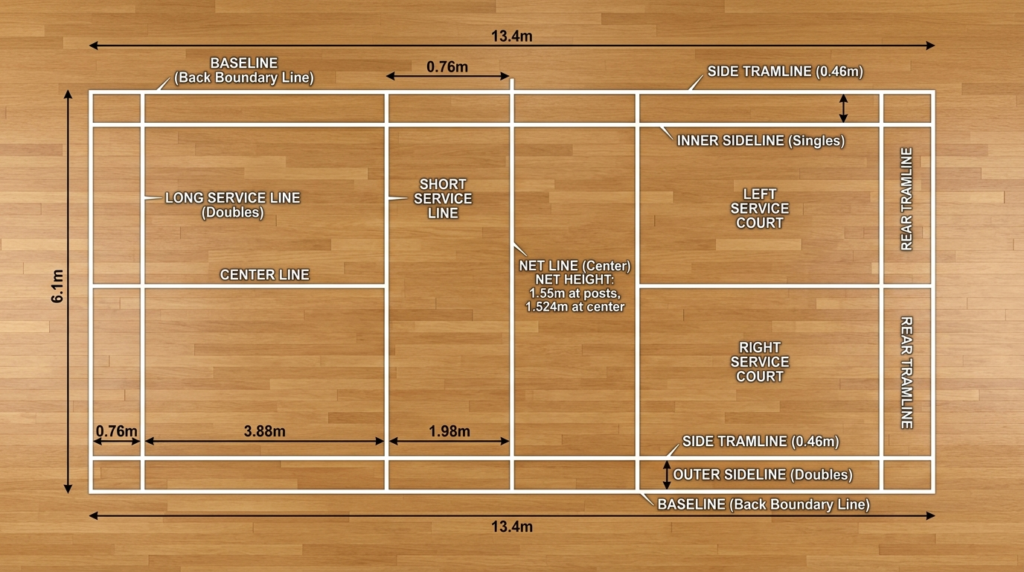
Net height is another essential part of shuttle court measurements:
- Center of net: 1.524 meters (5 feet)
- Net posts: 1.55 meters (5 feet 1 inch)
Why the Net Is Not Flat
The net is slightly lower in the center because:
- Gravity naturally pulls the net downward
- Posts are higher to maintain tension
- This creates consistent shuttle clearance behavior
Net Positioning Best Practices
For correct setup:
- Posts must sit on doubles sidelines
- Net must be tightly stretched
- Height should be measured before matches
Incorrect net setup can significantly impact gameplay fairness.
Singles vs Doubles Court Differences
Key Dimensional Differences
| Feature | Singles | Doubles |
|---|---|---|
| Length | 13.4 m | 13.4 m |
| Width | 5.18 m | 6.1 m |
Gameplay Impact
Singles:
- Requires endurance and full-court coverage
- Longer rallies
- Greater focus on footwork efficiency
Doubles:
- Faster rallies
- Strong net play
- Wider defensive coverage
Strategic Importance of Width
The wider doubles court:
- Opens attacking angles
- Demands faster lateral movement
- Encourages aggressive positioning
Metric vs Imperial Measurement Standards
Global Measurement Systems
Shuttle court measurements use both systems:
- Metric: meters, square meters
- Imperial: feet, square feet
Conversion Reference Table
| Measurement | Metric | Imperial |
|---|---|---|
| Length | 13.4 m | 44 ft |
| Doubles width | 6.1 m | 20 ft |
| Singles width | 5.18 m | 17 ft |
| Net height (center) | 1.524 m | 5 ft |
Why Standardization Matters
Standardization ensures:
- Equal playing conditions
- Consistent court construction
- Fair competition worldwide
Step-by-Step Guide to Measuring a Shuttle Court
Tools Required
- Measuring tape
- Chalk or paint
- String line
- Right-angle guide
Step 1: Mark Court Length
- Measure 13.4 meters
- Mark both baselines
Step 2: Mark Width
- 6.1 meters for doubles
- 5.18 meters for singles
Step 3: Add Service Lines
- Short service line near net
- Center line in middle
- Long service line for doubles
Step 4: Check Accuracy
- Ensure diagonals are equal
- Confirm 90-degree corners
Step 5: Final Inspection
- Recheck all measurements
- Ensure straight, visible lines
Indoor vs Outdoor Shuttle Court Setup
Indoor Courts
- Controlled environment
- Consistent lighting
- Stable shuttle flight
Common surfaces:
- Wooden flooring
- Synthetic mats
Outdoor Courts
Challenges include:
- Wind interference
- Uneven surfaces
- Sunlight glare
Gameplay Differences
Outdoor conditions often result in:
- Shorter rallies
- Unpredictable shuttle movement
- Stronger reliance on power shots
Common Mistakes in Shuttle Court Measurements
Frequent errors include:
- Incorrect singles width marking
- Misaligned center line
- Wrong net height at posts
- Unequal diagonals
- Faded boundary lines
Why These Mistakes Matter
Incorrect measurements can lead to:
- Fault disputes
- Unsafe movement areas
- Reduced training quality
- Unfair gameplay conditions
Professional Standards and Tournament Requirements
Professional courts must strictly follow official badminton regulations.
Tournament standards require:
- Accurate court dimensions
- Verified net height
- Clearly visible boundary lines
- Approved flooring materials
Officials often inspect courts before matches to ensure precision.
Maintenance and Long-Term Accuracy
Why Maintenance Matters
Courts can lose accuracy due to:
- Wear and tear
- Floor movement
- Faded markings
Maintenance Checklist
- Repaint lines regularly
- Measure net height before play
- Check surface level
- Inspect boundary clarity
Real-World Importance of Precision
Even minor measurement errors can:
- Affect footwork timing
- Change shuttle landing perception
- Create unfair advantages
That is why professional courts prioritize accuracy above everything else.
Conclusion
Understanding shuttle court measurements is essential for building or maintaining a proper badminton court. From court length and width to net height and service lines, every detail influences gameplay quality and fairness.
When measurements are done correctly, the court supports fast, balanced, and competitive play exactly as the sport is designed to be.